Scaling Scientific Labor
with Agentic Engineering
CosmoStat, CEA Paris-Saclay
FORTH Workshop on Physics-Informed Machine Learning
September 18, 2026


Three questions
- What can agentic systems accomplish now?
- What engineering constraints emerge from these systems?
- Which kinds of scientific labor scale under these constraints?
What can agentic systems accomplish now?
The hardest problems are being solved by swarms
Yesterday’s frontier costs pennies today
Sources & accounting notes
ARC Prize: o3 score & retrospective cost · ARC Prize: DeepSeek score & cost · OpenAI: Navier–Stokes token count · Prompted by prinz
ARC-AGI-1 semi-private evaluation; different systems and inference budgets. o3’s $4,560 is a retrospective estimate using o3-pro pricing. DeepSeek High: 87.0% at $0.021402901/task.
Astra retail output price: $50/M. Navier–Stokes: 130B output tokens × $50/M = $6.5M, output-only retail equivalent, not disclosed internal spend. The benchmark comparison does not predict future Navier–Stokes cost.
What does this mean for scaling our personal research?
- Agentic approaches can solve hard scientific problems.
- Certain kinds of scientific labor will scale with tokens.
- Tokens at fixed capabilities get cheaper, intensifying this scaling.
- Computational approaches can solve hard scientific problems.
- Certain kinds of scientific labor will scale with computation.
- Computation at fixed capabilities gets cheaper, intensifying this scaling.
Sources & notes
NASA: Langley’s human computers, 1935–1970. The transition was gradual; some human computers took on programming duties, and the job title persisted into the 1960s. This is an analogy about changing work, not an exact forecast of displacement.
A roadmap for the rest of the talk
- Do you want to work this way?
- If you do, which parts do you want to scale?
What engineering constraints emerge from these systems?








From oracles to agents
Harnesses are working environments, like IDEs



Environment: files, shell, remote machines, browser
Context is similar to RAM
Cache rules everything around me
Sources & notes
OpenAI: prompt caching (animation adapted from “What is the prompt cache?”); OpenAI pricing; Claude pricing; Thariq: Prompt Caching Is Everything.
Rates checked September 17, 2026. Astra and Fable 5.1 both have $10/M base input, $12.50/M short-cache writes and $50/M output; cache reads are $1/M and $0.25/M respectively. Astra: standard short-context API pricing. Fable: five-minute cache writes; one-hour writes cost $20/M. Read multipliers are 0.1× and 0.025× respectively; output 5×. Prices exclude batch, fast mode, regional uplifts and other modifiers.
Illustrative Astra short-context accounting: Turn 1 writes a 100k-token prefix ($1.25) and generates 20k output tokens ($1). Turn 2 hits the original 100k ($0.10), writes the previous 20k-token answer ($0.25) plus a 4k-token user follow-up ($0.05), and generates another 20k ($1). Turn 5 continues the same pattern: its cached prefix is 100k + 3 × 24k = 172k tokens ($0.172), followed by the latest 20k-token assistant answer ($0.25 write), a 4k-token user addition ($0.05 write), and 20k output ($1). Turns 3–4 are omitted; each adds 24k tokens to the next cached prefix. All bars share a linear scale of 6.02 SVG units per 1,000 tokens. The initial prefix consists of 96k instructions/tool tokens and a 4k user message; arrows are fixed separators, not tokens. The example assumes the indicated cache hits; actual reusable boundaries depend on the service. Fable 5.1 read costs are one quarter of these Astra read costs. KV states, not a ready-made answer, are cached.
Retention is model-specific: Astra’s documented minimum is 30 minutes after write/reuse; Claude offers five-minute and one-hour writes. Older OpenAI in-memory caches typically last 5–10 minutes of inactivity, up to one hour.
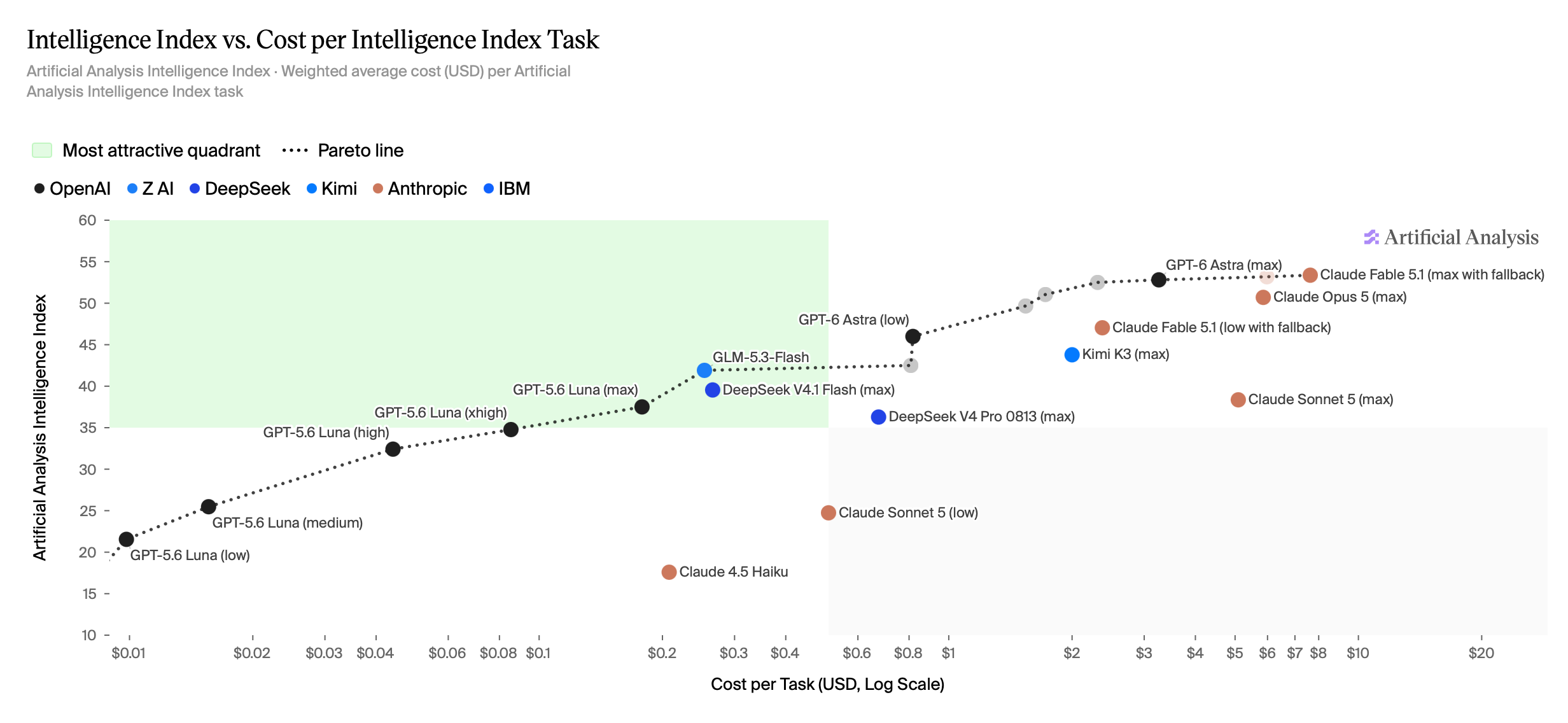
Benchmarks aren’t everything
Sources & notes
Artificial Analysis, Intelligence Index vs. Cost per Intelligence Index Task. Chart downloaded September 17, 2026. Original full-resolution export; the chart retains its attribution and benchmark definitions.
Plugins allow you to customize your harness
Delegate to sub-agents for scoped work
Teams coordinate while the work is happening
Workflows express loops and parallelism on the fly
With great output comes great chaos
Lightcone Research
lightconeresearch.org
 CNRS AISSAI and BIDS / UC Berkeley

Live Demo: Measure Dark Energy in 15 Minutes
Give your agent Lightcone tools
uv (Python package and project manager) installed:
lightcone-cli:
Claude Code
Codex
Sources & notes
uv installer · Lightcone plugins
The CLI block creates and enters /tmp/lightcone-demo, reusing it if it already exists. Run the setup and your chosen agent in the same terminal. Copy out results you want to keep before the operating system clears temporary files. The uv installer and CLI use their standard user-level installation locations. The CLI includes astra-tools; the Lightcone plugin bundles ASTRA guidance and hooks. Start a fresh agent session after installation. Create the analysis with prompt 1 before opening JupyterLab.
1. Kick off an analysis with Lightcone
I’d like to use Lightcone tools to analyze the Union2.1 supernova compilation from the Supernova Cosmology Project. Let’s write an ASTRA analysis that fits a flat LCDM model to this data and recovers Omega_Lambda.
Please produce two outputs: the best fit Omega_Lambda with uncertainties, and a downstream Hubble diagram figure with an absolute panel and a residuals panel. As you go, briefly walk me through each ASTRA element that you add; this is a live tutorial! Don’t add any decisions yet.
View the analysis in JupyterLab
Sources & notes
Jupyter AI setup · Node and npm package
Optional viewer and chat setup for macOS/Linux. The project already exists when the viewer opens. Keep analysis files in the project directory and installed packages in its .venv subfolder. If prompt 1 created a project subdirectory, enter that directory first. These commands do not create a second temporary workspace. Both Claude Code and Codex ACP adapters are installed; continue using the terminal agent if preferred.
2. Did we reproduce the published result?
The paper that published this catalogue is Suzuki et al. 2012, arXiv 1105.3470. Can we compare our Omega_Lambda to their supernova-only constraint?
3. What changes when we include systematics?
Let’s improve our systematics treatment to reproduce their published result. Track all changes as ASTRA decisions.
Just talk to the model!
Convey intent rather than commands.
Voice / transcription is faster and gives the model a richer picture of your intent.
Meeting transcripts are a goldmine.
Have the model write everything down
Iterate on long-horizon work
Ask for HTML reports
Do you still need to read code?
Sometimes!
-
Define the high-level design before implementation
(product requirements document, etc.) -
Grill the model until you understand what it does.
Diagrams help. - Core code is worth reading.
Becoming a project manager
- Agents are like brilliant but amnesiac interns
- Agentic work pushes you towards doing many things at once
- You can only keep so many chats in your head at once...
Sources & notes
OpenAI: An open-source spec for Codex orchestration: Symphony. Video embedded from OpenAI’s Vimeo player; requires an internet connection.
Which kinds of scientific labor scale under these constraints?
Closing thoughts
The practice of research is being revolutionized.
If we change how we work, we can hold higher standards
and take on more ambitious problems.
“Of course I would rather not be swept away by the revolution.
But if I have to be, then I would rather be the one who revolutionizes myself.”
Sources & notes
English translation posted by Teortaxes. Translation credited in the post to Astra-xhigh. Quote wording supplied by Cail. Original author identity has not been independently verified. Lightcone tutorial and agent skills.Cail Daley | FORTH PIML Workshop | September 18, 2026 | cailmdaley.github.io/talks/2609_FORTH_Crete/