UNIONS-3500 Weak Lensing:
\(B\)-mode validation for cosmic shear


Cail Daley

CosmoStat, CEA Paris-Saclay

on behalf of the UNIONS weak lensing team


Euclid Weak Lensing SWG telecon

April 27, 2026

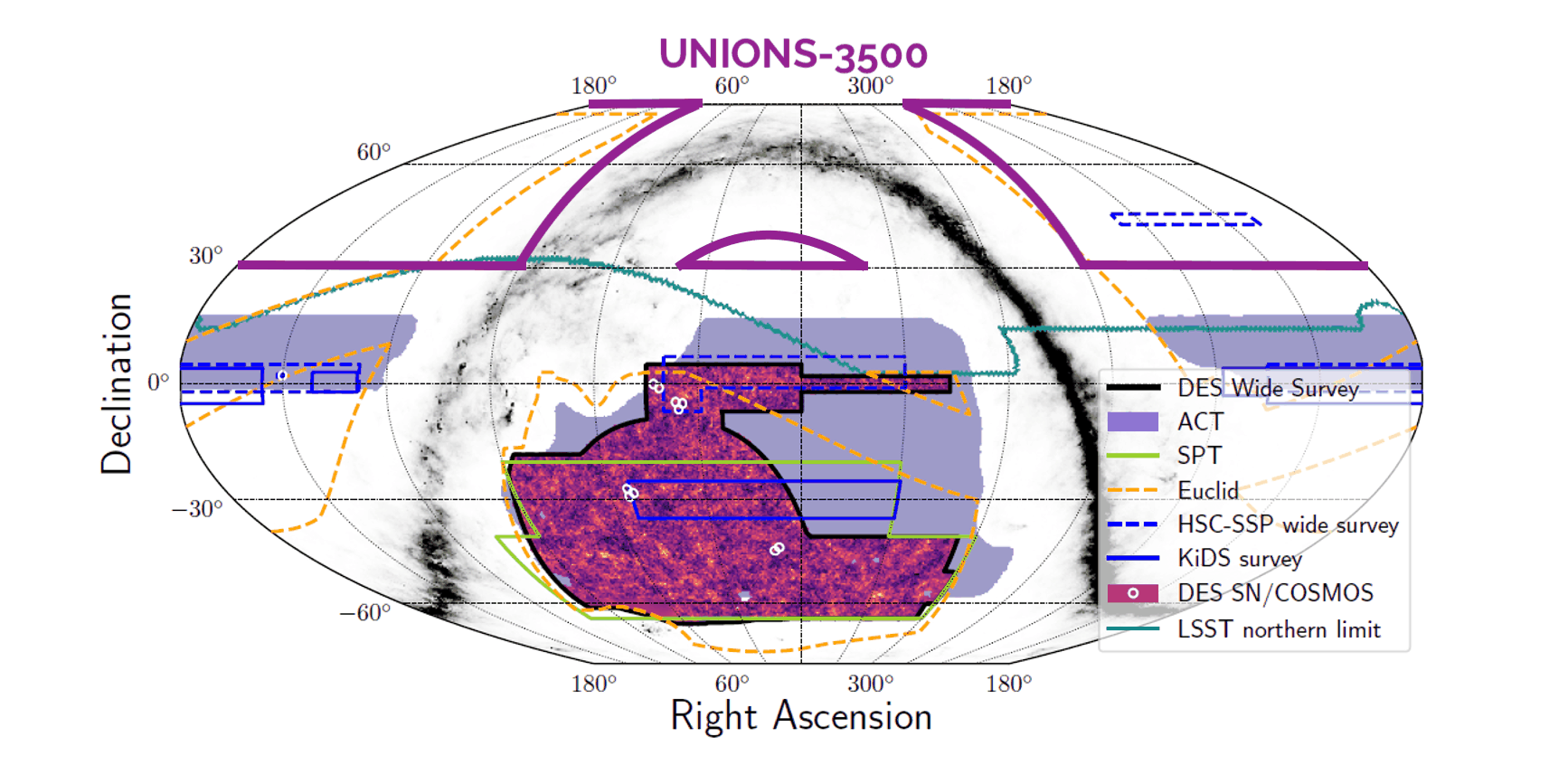
UNIONS is the first wide-field lensing survey in the northern sky
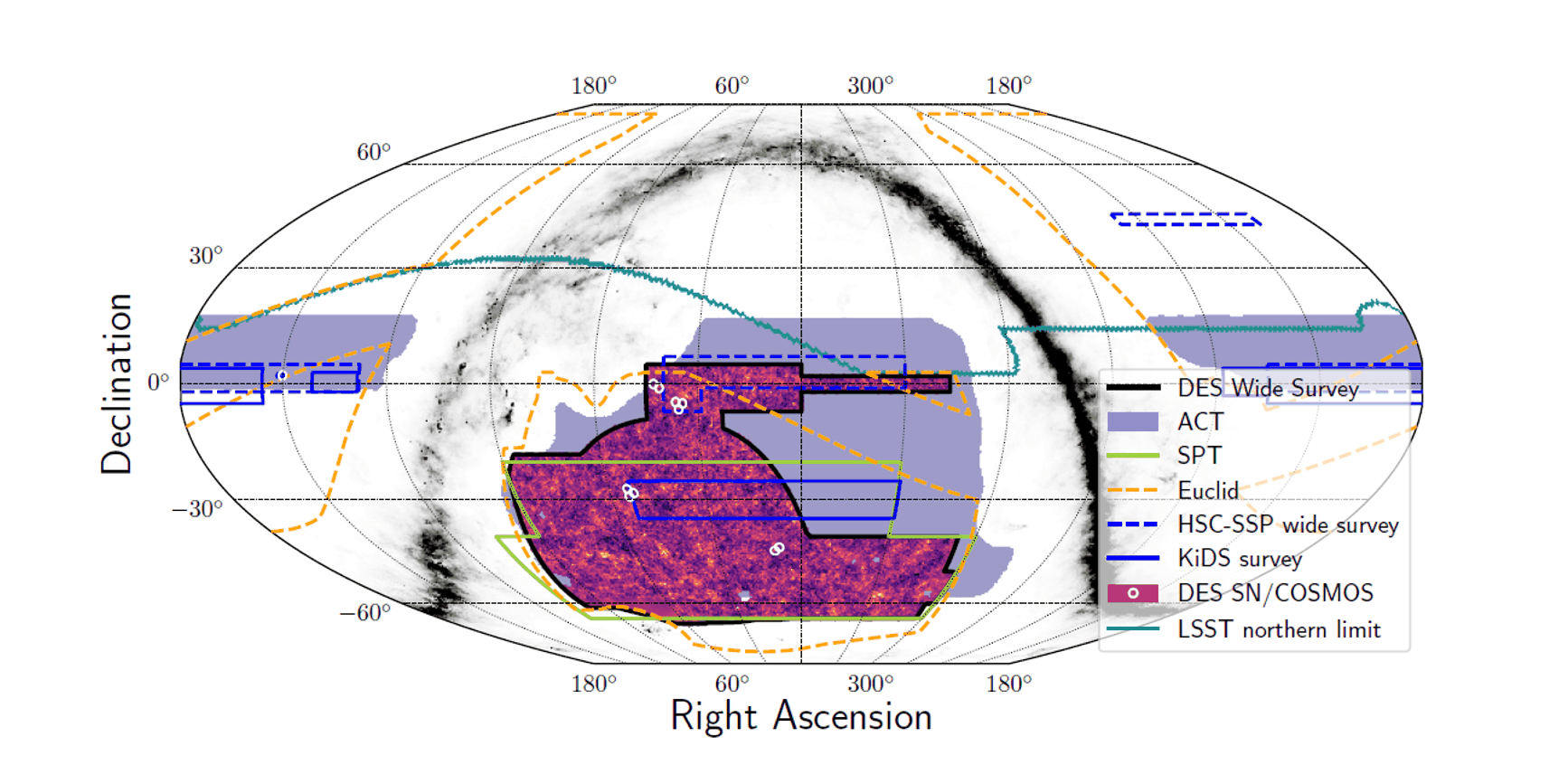
Credit: DES Collaboration

UNIONS-3500 at a glance

Imaging CFHT MegaCam \(r\)-band; \(r_\mathrm{median} = 0.7''\)
Effective area \(2894~\mathrm{deg}^2\) after masking
(target \(6250~\mathrm{deg}^2\))
Source density \(n_\mathrm{eff} \approx 5.0~\mathrm{arcmin}^{-2}\)
Shape noise \(\sigma_e \approx 0.27\) per component
Shape measurement ShapePipe + metacalibration

Non-tomographic in this release; multi-bin calibration in preparation.

Paper II validates B modes for the UNIONS-3500 release

  • Paper I — Catalogues (Hervas-Peters et al.)
  • Paper II\(B\)-mode validation (this work)
  • Paper III — Configuration-space cosmology (Goh et al.)
  • Paper IV — Harmonic-space cosmology (Guerrini et al.)
  • Paper V — Image simulations (Hervas-Peters et al.)

Paper II sets the scale cuts adopted in Papers III and IV.

Cosmic shear produces \(E\) modes; \(B\) modes flag systematics

  • Scalar potential → curl-free shear field → only \(E\) modes to leading order
  • Higher-order effects produce \(B\) modes far below current sensitivity
  • At Stage-III, \(B\) modes flag residual systematics
  • Null \(B\) modes do not rule out contamination
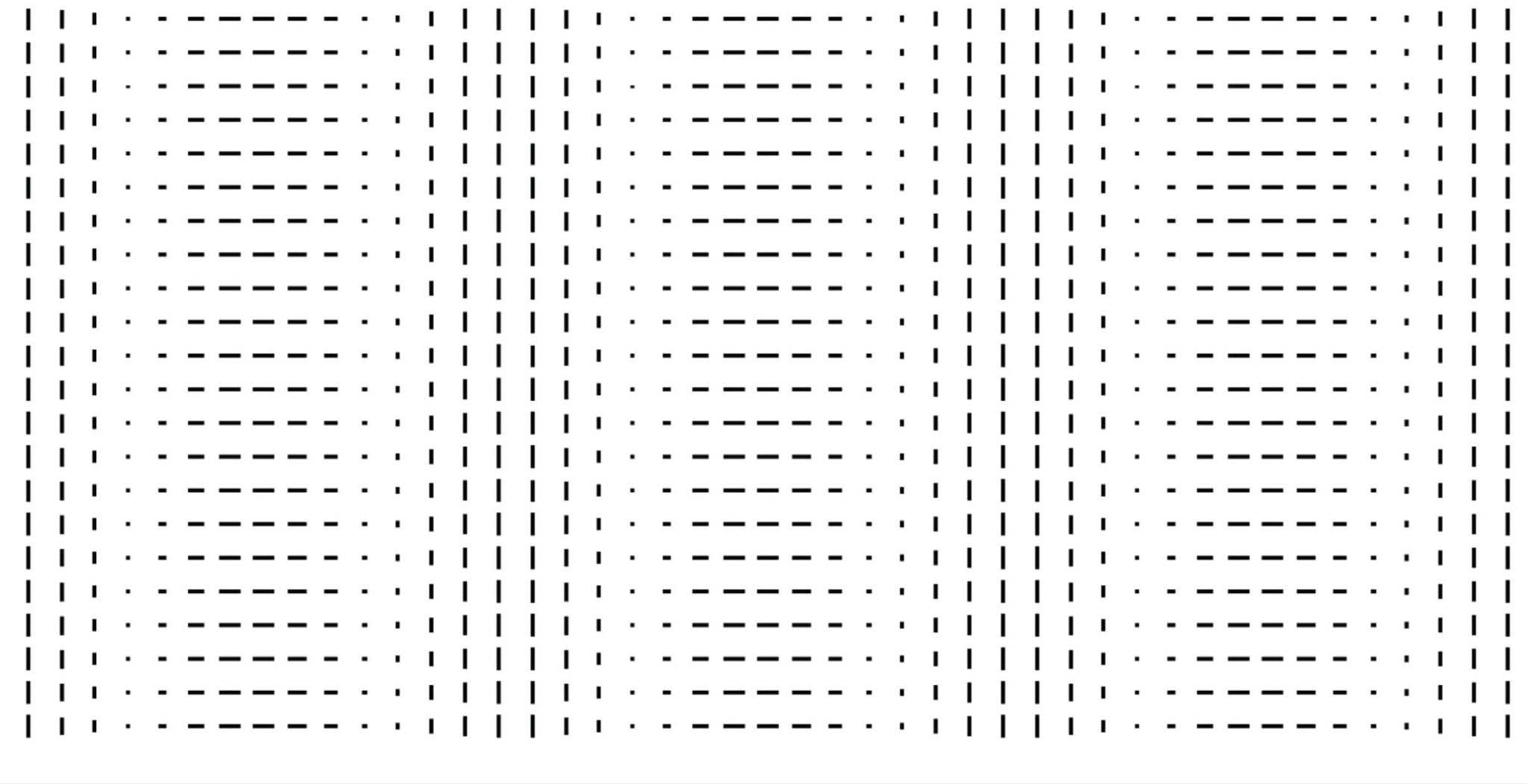
\(E\) modes (gradient-like)
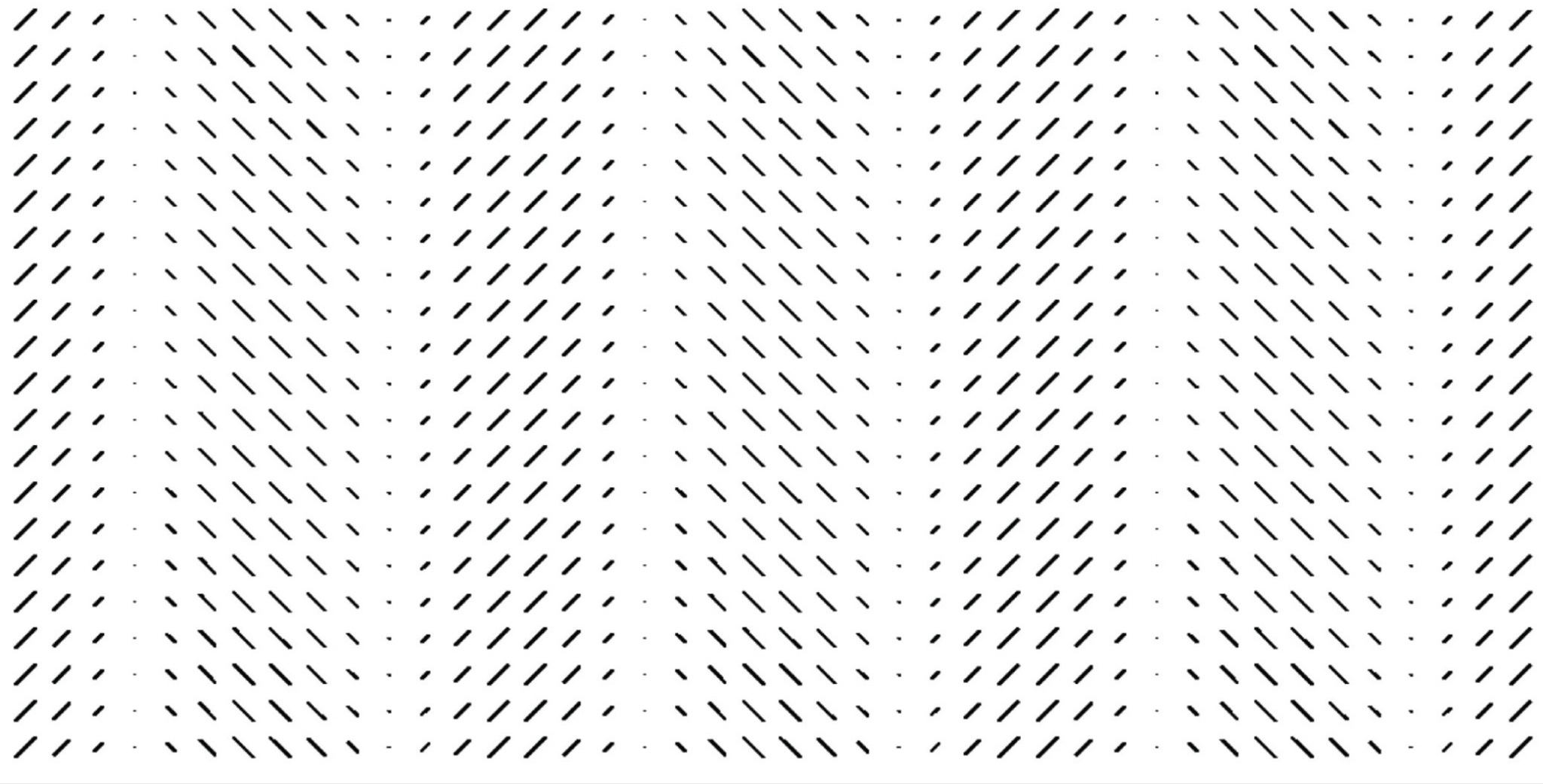
\(B\) modes (curl-like)

Stage-III B-mode failures trace
detector, PSF, and astrometric effects

  • Repeating additive shear bias — CFHTLenS, KiDS-450, DES-SV [Asgari+19]
  • PSF higher-moment leakage — HSC-Y3 [Zhang+23]
  • Astrometric residuals — KiDS-Legacy [Wright+25]
  • HybridEB flips DES-Y3, KiDS, HSC-Y3 from pass to fail [Jefferson+25]
    • …yet DES-Y6 itself adopts HybridEB and passes — only one appendix figure and two paragraphs of discussion [DES-Y6]

Each estimator weights angular scales differently; the same data can pass one and fail another.

Three Stage-III surveys see the same oscillatory \(B\)-mode pattern

  • Three surveys, three pipelines
  • \(B_n\) panels (right): same coherent oscillation
  • Survey \(p\)-values differ, the shape doesn’t
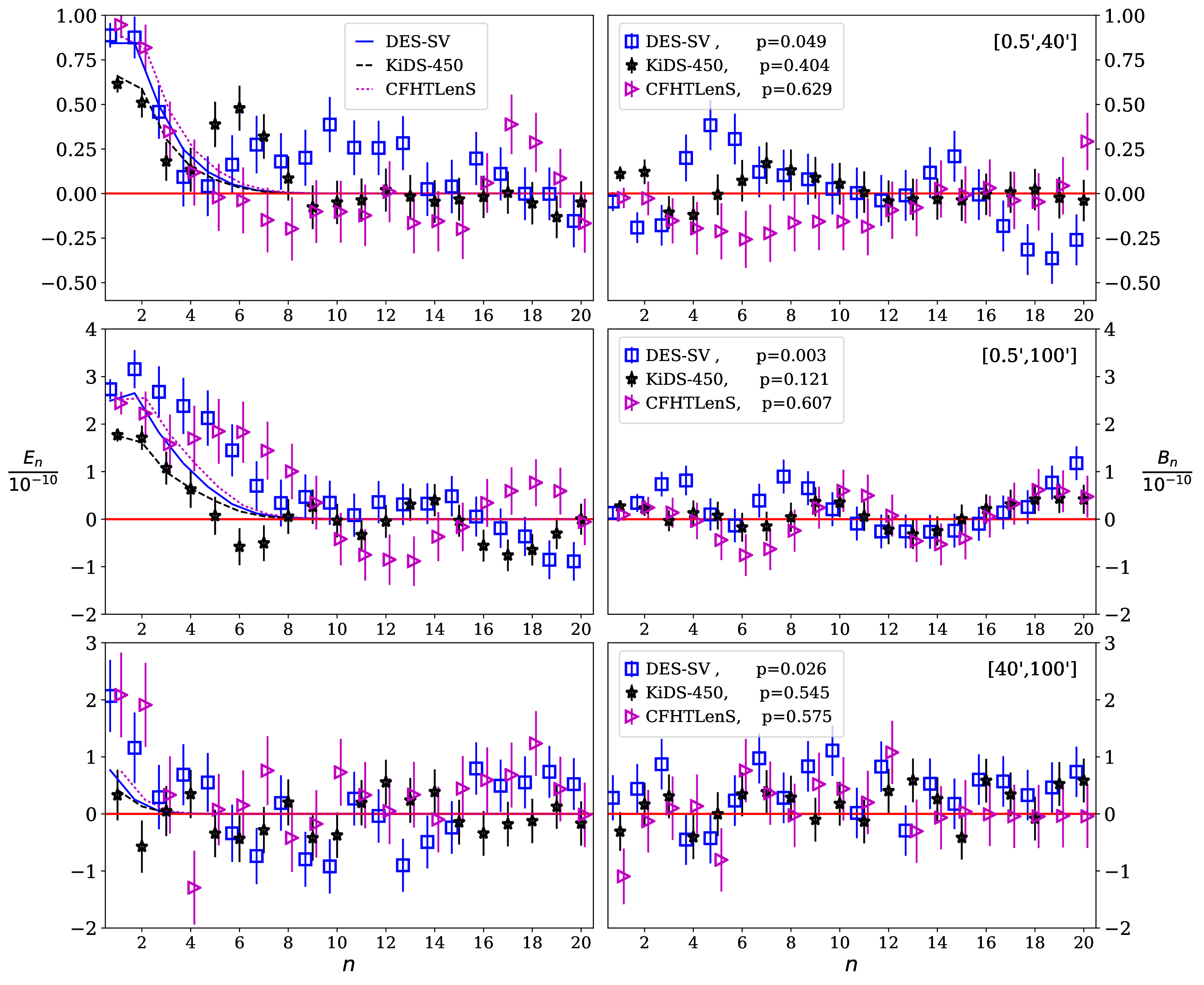
COSEBIs \(E_n\) / \(B_n\) — DES-SV, KiDS-450, CFHTLenS. From Asgari+19.

Mock systematics in COSEBIs each leave a distinct fingerprint

  • One systematic, one signature
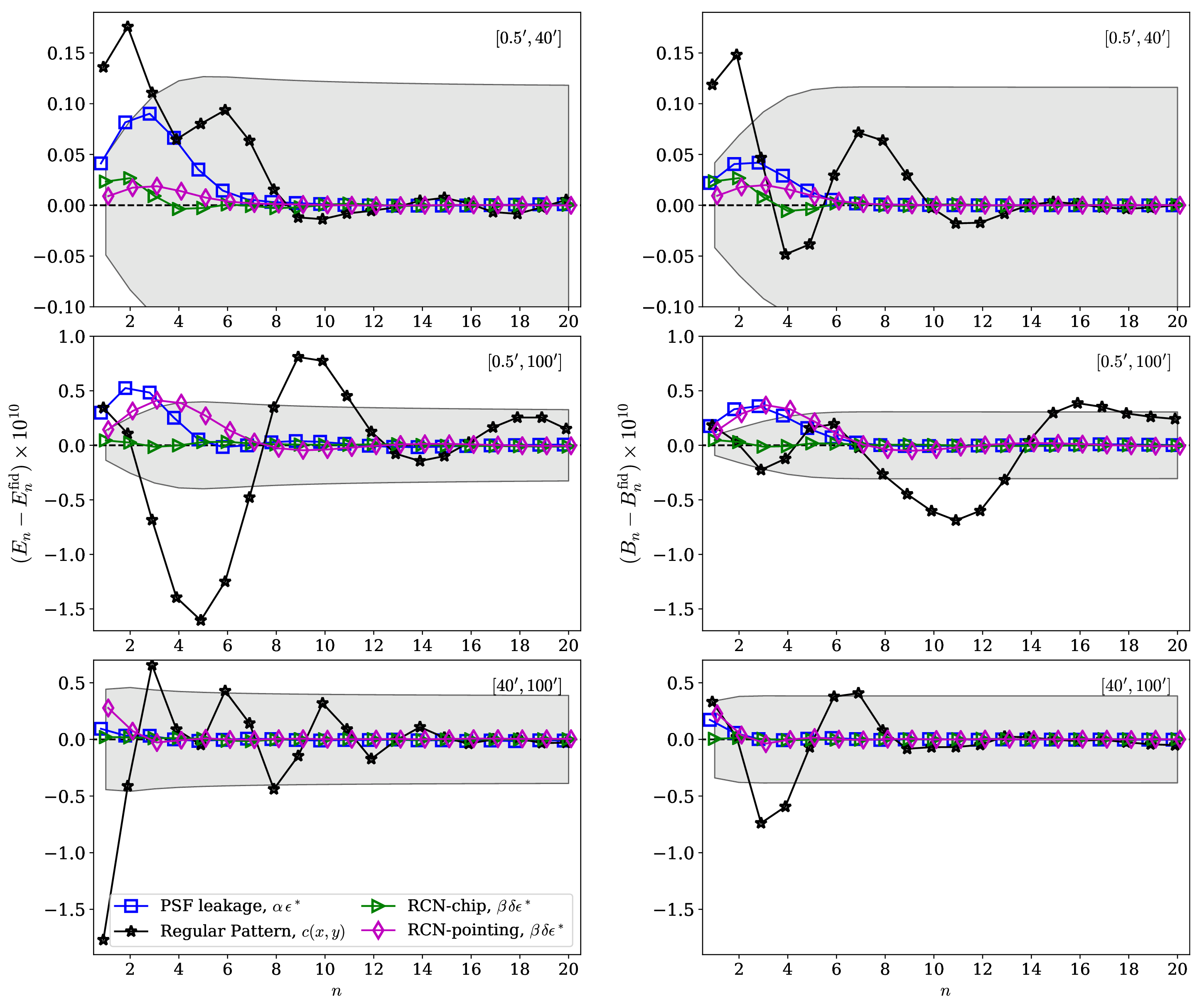
  • Regular pattern (black): chaotic high-\(n\) oscillations — matches the surveys’ data
  • High-\(n\) carries the fingerprint

COSEBIs response to four mock systematics on KiDS-450. From Asgari+19.

We use three \(E\)/\(B\)-separable statistics
with different filter supports

  • Pure-mode correlation functions \(\xi_\pm^{\mathrm{E/B}}(\theta)\)   [Schneider+22]
    • integral transforms of \(\xi_\pm\); deproject ambiguous modes
  • COSEBIs \(E_n, B_n\)   [Schneider+10]
    • discrete orthogonal modes on \([\theta_\mathrm{min}, \theta_\mathrm{max}]\); deproject ambiguous modes
  • Catalog-based \(C_\ell^{EE}, C_\ell^{BB}\)   [Wolz+25]
    • spin-2 SHT at source positions; residual \(E{\to}B\) leakage absorbed into \(C_\ell^{BB}\)

Gaussian-only covariance (CosmoCov + NaMaster iNKA), validated on 350 GLASS mocks [Tessore+23] — PTEs are conservative.

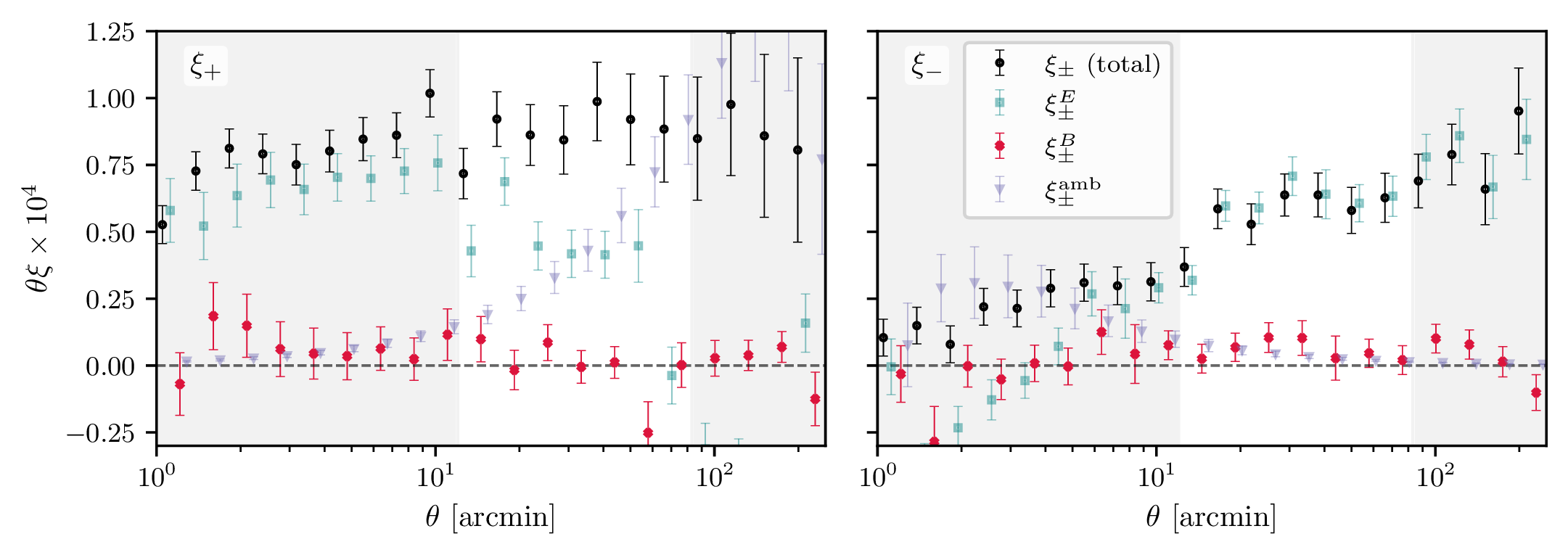
Pure-mode \(B\) modes show low-level structure
outside the adopted cuts
COSEBIs and \(C_\ell^{BB}\) also pass within the adopted range

  • COSEBIs \(B_n\)
    • \(>4\sigma\) first-mode excess at full range
    • Suppressed by the cuts; first six modes carry the cosmology
  • Harmonic-space \(C_\ell^{BB}\)
    • Low-level offset across \(\ell\)
    • Passes within the adopted range \(\ell\in[300,1600]\)
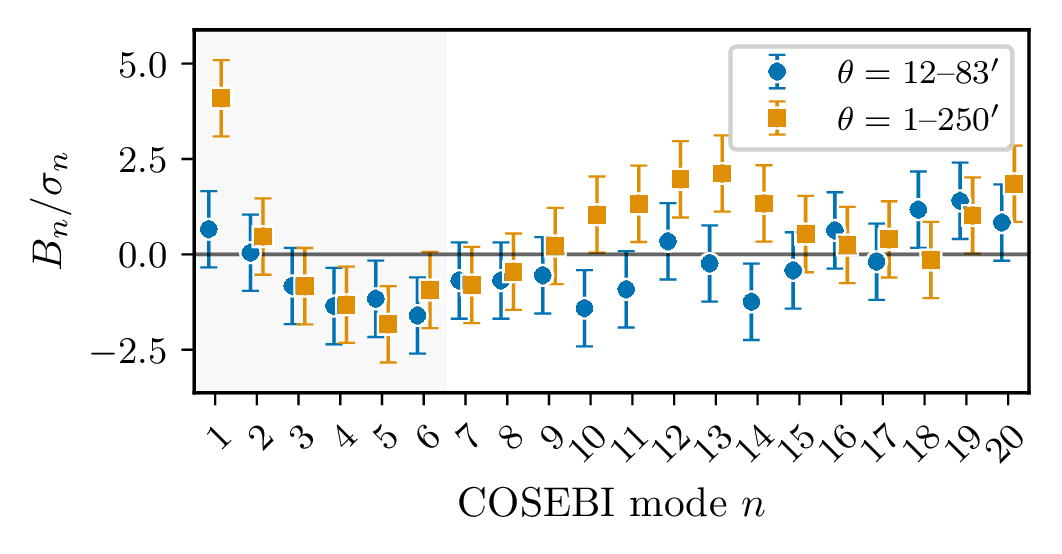
Full range (orange), fiducial cuts (blue).
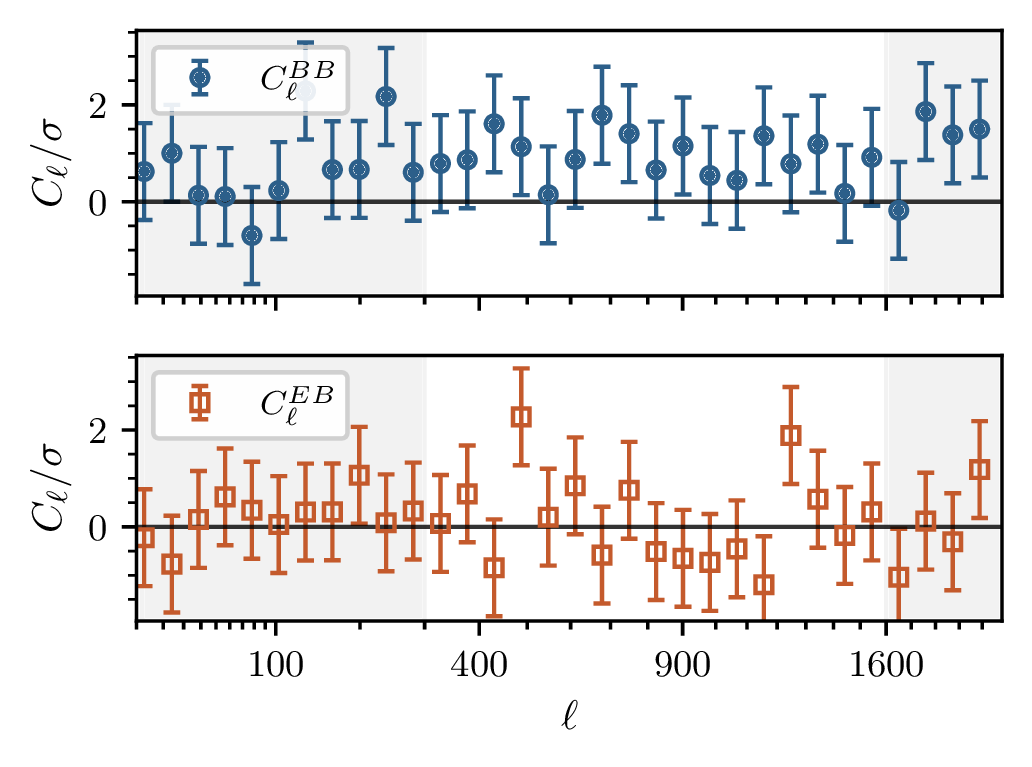
\(C_\ell^{BB}/\sigma\) top, \(C_\ell^{EB}/\sigma\) bottom.

Only the fiducial catalog passes all three statistics

initial
loose size cut

fiducial
\(r_\mathrm{gal}/r_\mathrm{psf} > 0.707\)

masked
fiducial + star-halo masks

relaxed-flags
\(+23\%\) source density
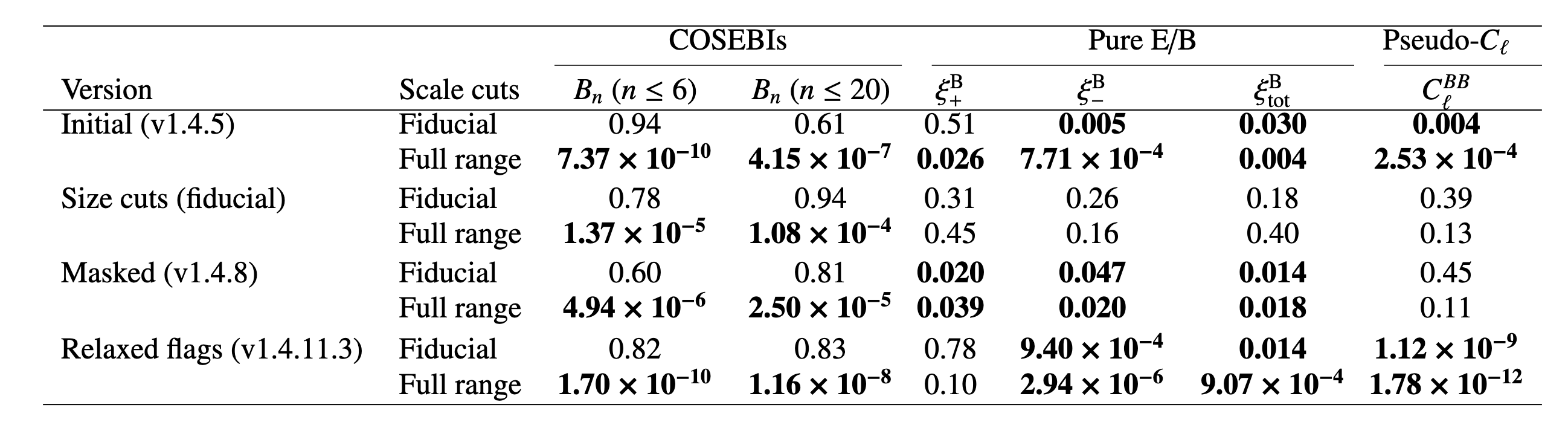
Bold entries fail the null test (PTE \(< 0.05\)).

The adopted cuts sit in broad PTE-pass regions

  • \(\chi^2\) vs. zero per \((\theta_\mathrm{min},\theta_\mathrm{max})\) cut
  • Adopted: \(\theta\in[12',83']\), \(\ell\in[300,1600]\)
  • Moving cuts several bins either way doesn’t change the outcome
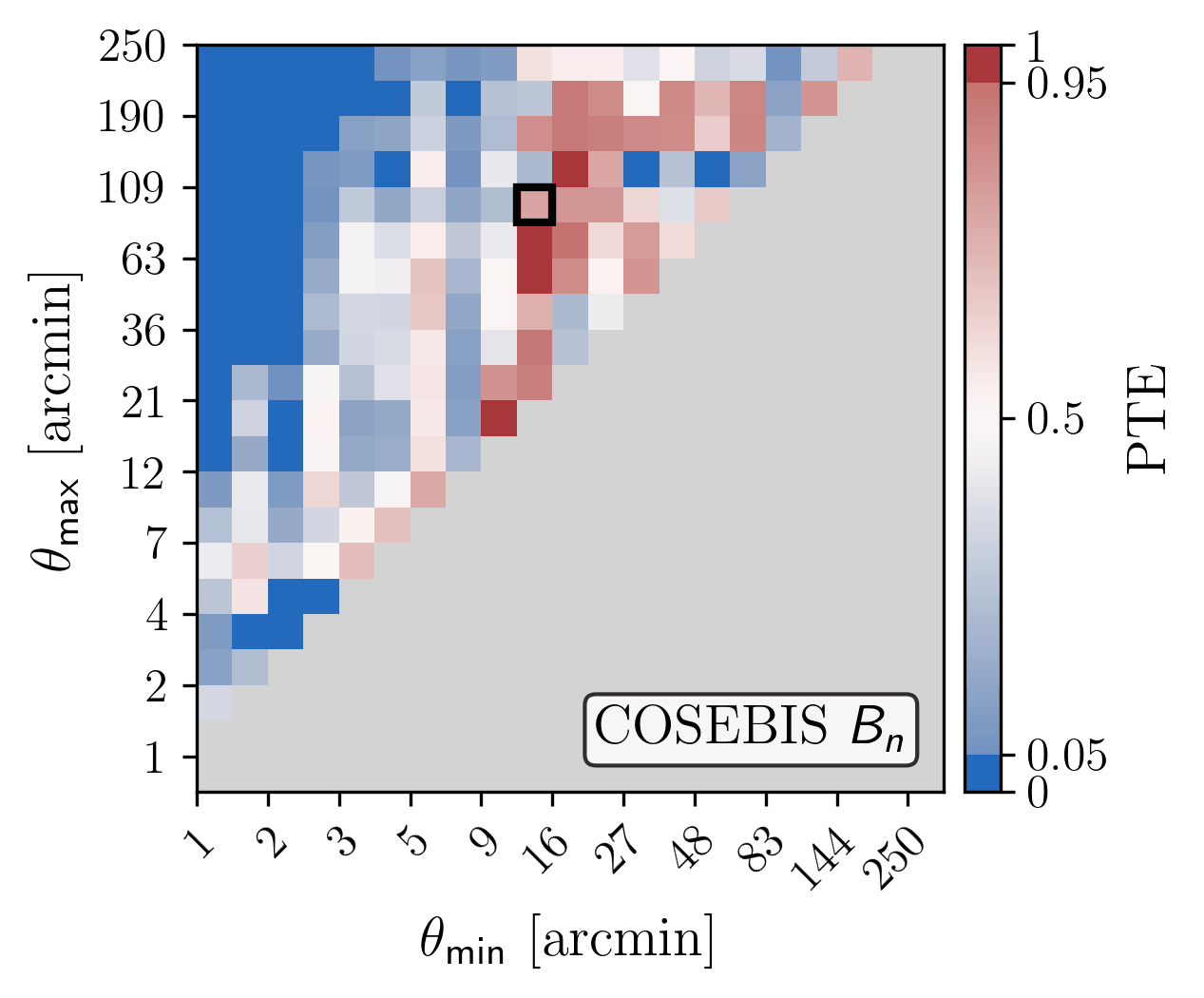
COSEBIs PTE vs. lower/upper scale cut. Square: adopted cuts.

Filter functions weight scales differently —
cuts don’t map between estimators
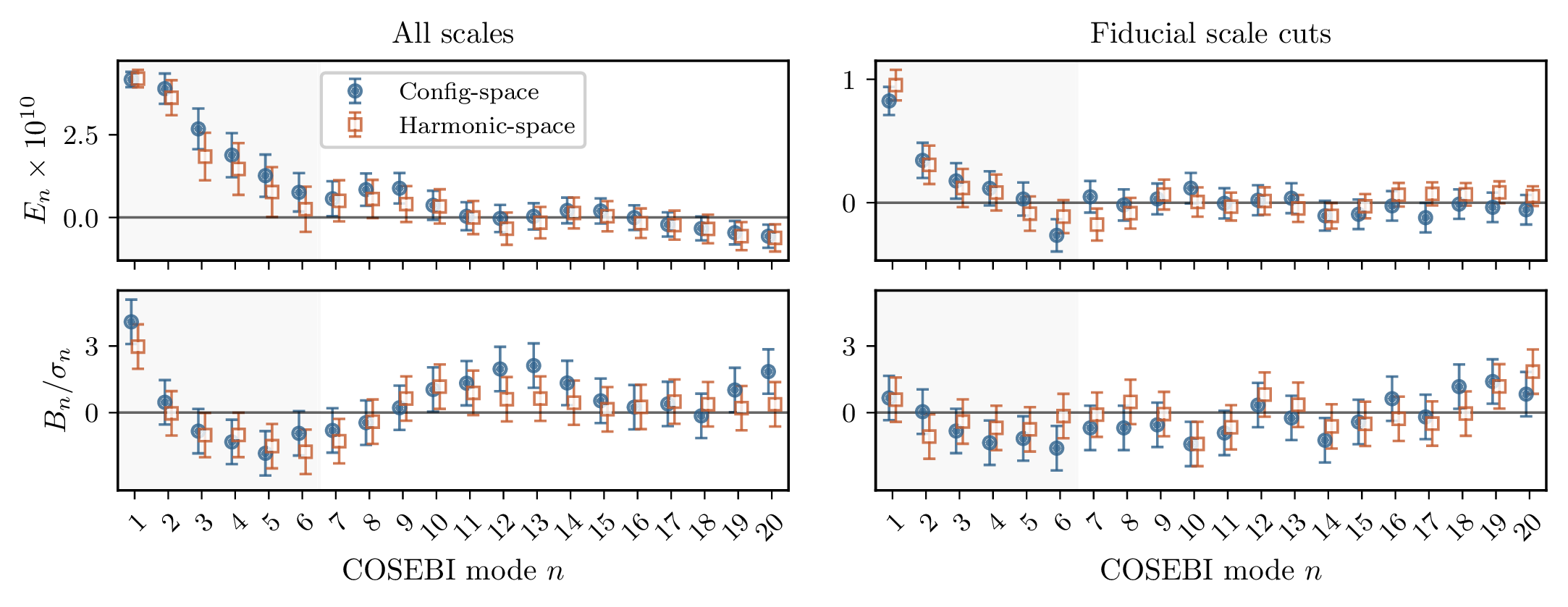
\(E_n\) (top), \(B_n/\sigma_n\) (bottom), from \(\xi_\pm\) (circles) and \(C_\ell\) (squares).

  • COSEBIs computed from \(\xi_\pm\) and from \(C_\ell\) via \(W_n(\ell)\) agree across all 20 modes
  • \(C_\ell^{BB}\) itself passes — but COSEBIs from the same \(C_\ell\) do not
  • COSEBI filters concentrate sensitivity where the contamination sits

Our oscillatory COSEBIs match a familiar
Stage-III B-mode signature

  • The same oscillatory \(B_n\) pattern recurs in CFHTLenS, KiDS-450, DES-SV [Asgari+19]
  • Asgari+19 model it as a spatially varying \(c\)-term fixed in focal-plane coordinates (right) — but the recurrence across detectors hints at something more general
  • A localized-in-\(\theta\) contamination, viewed through orthogonal COSEBI filters, naturally produces oscillations in \(B_n\)
  • Either way, our \(12'\) lower cut excludes the angular range where the pattern lives
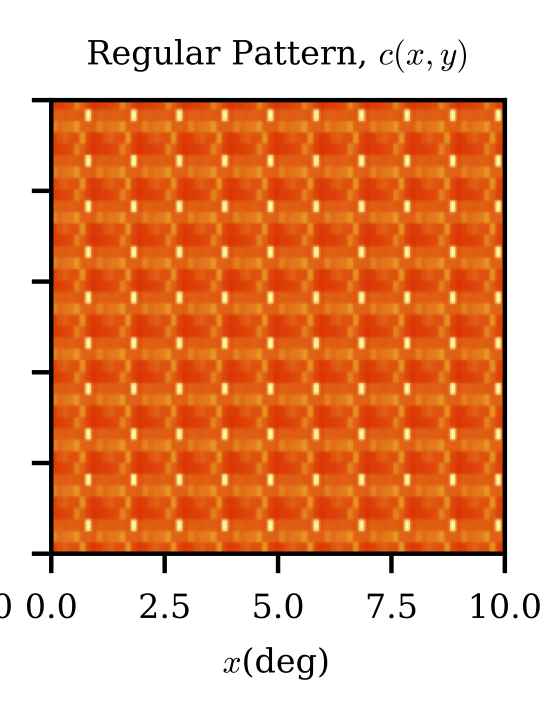
Repeating focal-plane \(c\)-term mock, \(5\times\) amplified. Credit: Asgari et al. 2019.

Paper V identifies an additional pipeline-level source at CCD scales

  • Multi-exposure fitting centers on each exposure’s pixel grid independently, rather than the WCS-anchored tile-level detection
  • Pixel offsets between exposures in overlapping CCDs imprint a preferred orientation → coherent additive shear at CCD scale
  • Multiplicative bias absorbs part of it; the adopted cuts remove the rest

We couldn’t localize the source,
so we cut where all three statistics pass

  • We detected an oscillatory \(B\)-mode pattern in COSEBIs at the full angular range
  • We have not yet localized the source from first principles — two candidate mechanisms remain on the table
  • We adopted \(\theta_\mathrm{min}=12'\), \(\ell_\mathrm{max}=1600\), where pure-mode, COSEBIs, and \(C_\ell\) all pass
  • We cross-checked single-framework failures across the other two — only the fiducial catalog passes in every representation
  • We treated \(B\) modes as a diagnostic, not a bias to subtract: the cuts that remove \(B\)-mode contamination remove its \(E\)-mode counterpart too, with no \(E/B\)-ratio model

Summary

  • UNIONS-3500 \(B\) modes pass at the adopted cuts across all three statistics
  • At full range, our COSEBIs show an oscillatory pattern matching the CFHTLenS-era repeating additive bias (same MegaCam)
  • Only the fiducial (tightened-size-cut) catalog passes in every representation
  • Filter functions, not basis, drove which estimators flagged the contamination

Paper II on arXiv: arxiv.org/abs/2604.03227
cail.daley@cea.fr

Backup

Ambiguous modes arise on any finite interval

On a finite angular interval, shear patterns with functional forms \[\xi_+^{\mathrm{amb}}(\theta) = a + b\theta^2, \quad \xi_-^{\mathrm{amb}}(\theta) = c\theta^{-2} + d\theta^{-4}\] cannot be assigned pure \(E\)- or \(B\)-mode origin.


Pure-mode and COSEBI filters deproject these modes; the catalog-based \(C_\ell\) estimator absorbs residual mask-induced leakage into \(C_\ell^{BB}\).

Pure-mode \(B\) modes: data vectors across catalog versions
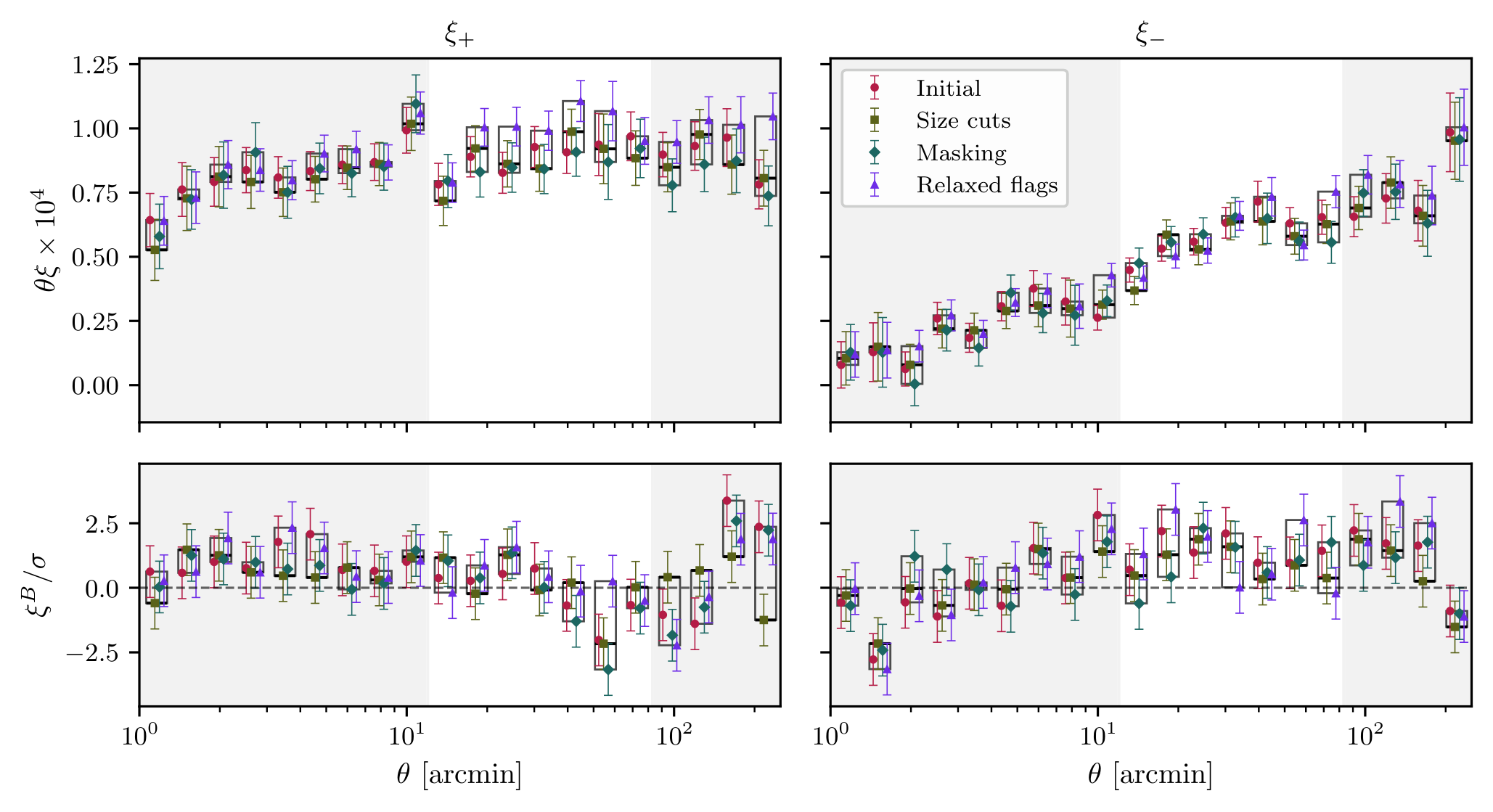
\(\xi_+\) (left), \(\xi_-\) (right); \(E\) (top), \(B/\sigma\) (bottom). Initial (red), fiducial size cuts (gold), \(+\)masking (teal), relaxed flags (purple). Shaded: outside adopted range.

COSEBIs \(B\) modes: data vectors across catalog versions
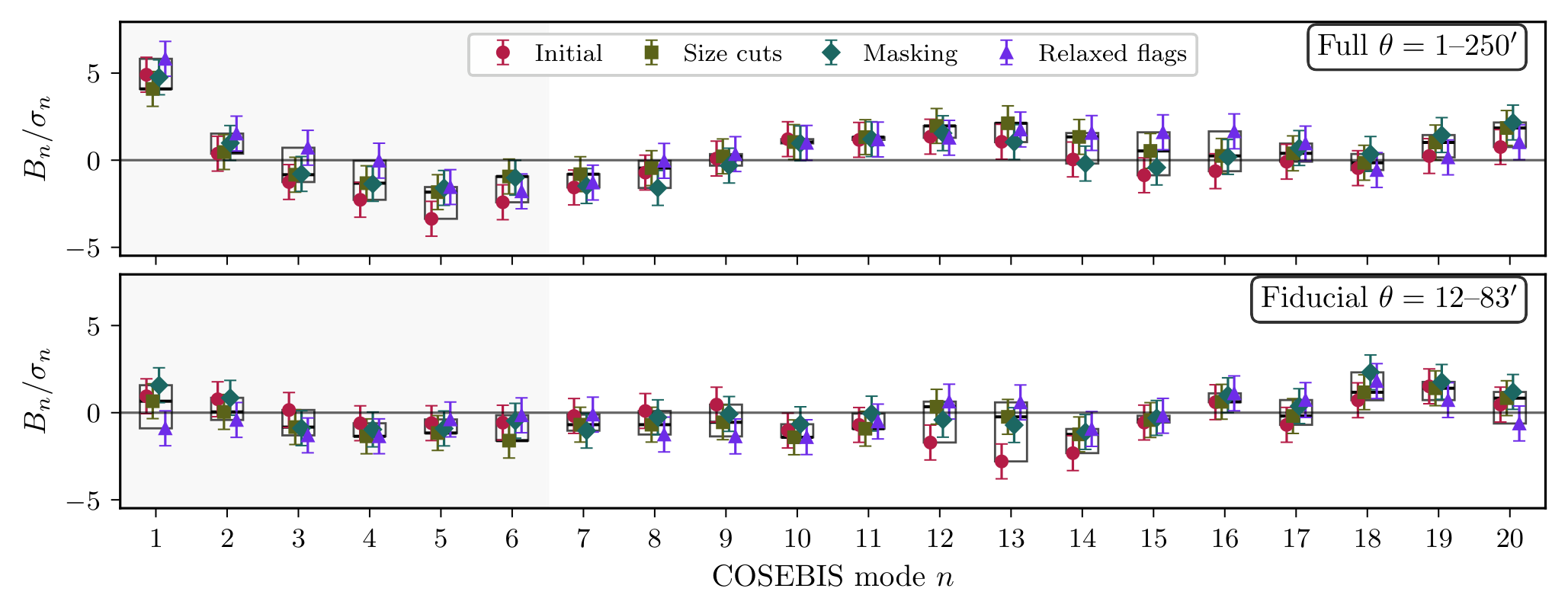
\(B_n\) stacked across catalog versions. Same colors: initial (red), fiducial (gold), masking (teal), relaxed flags (purple).

\(C_\ell^{BB}\): data vectors across catalog versions
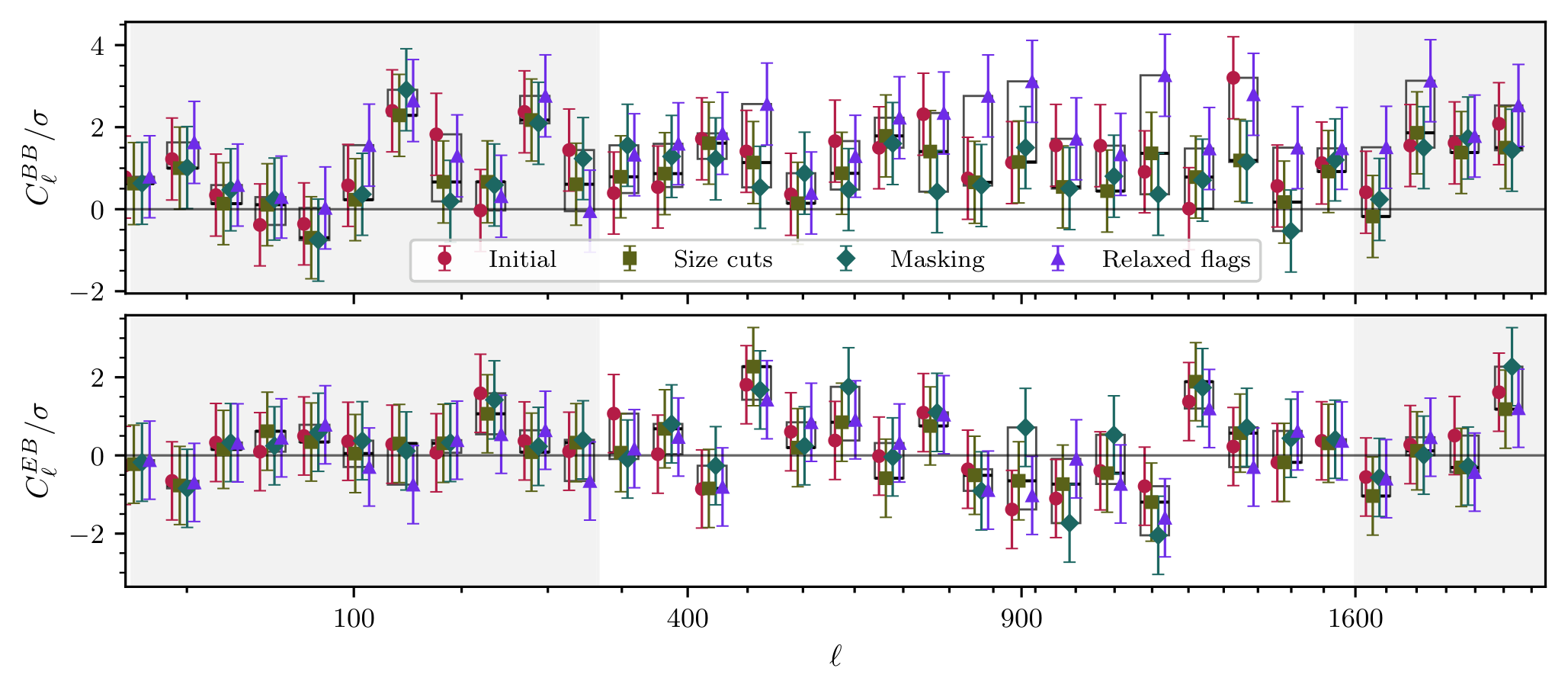
\(C_\ell^{BB}/\sigma\) across catalog versions. Same colors as above.

PTE maps across all catalog versions and config-space statistics
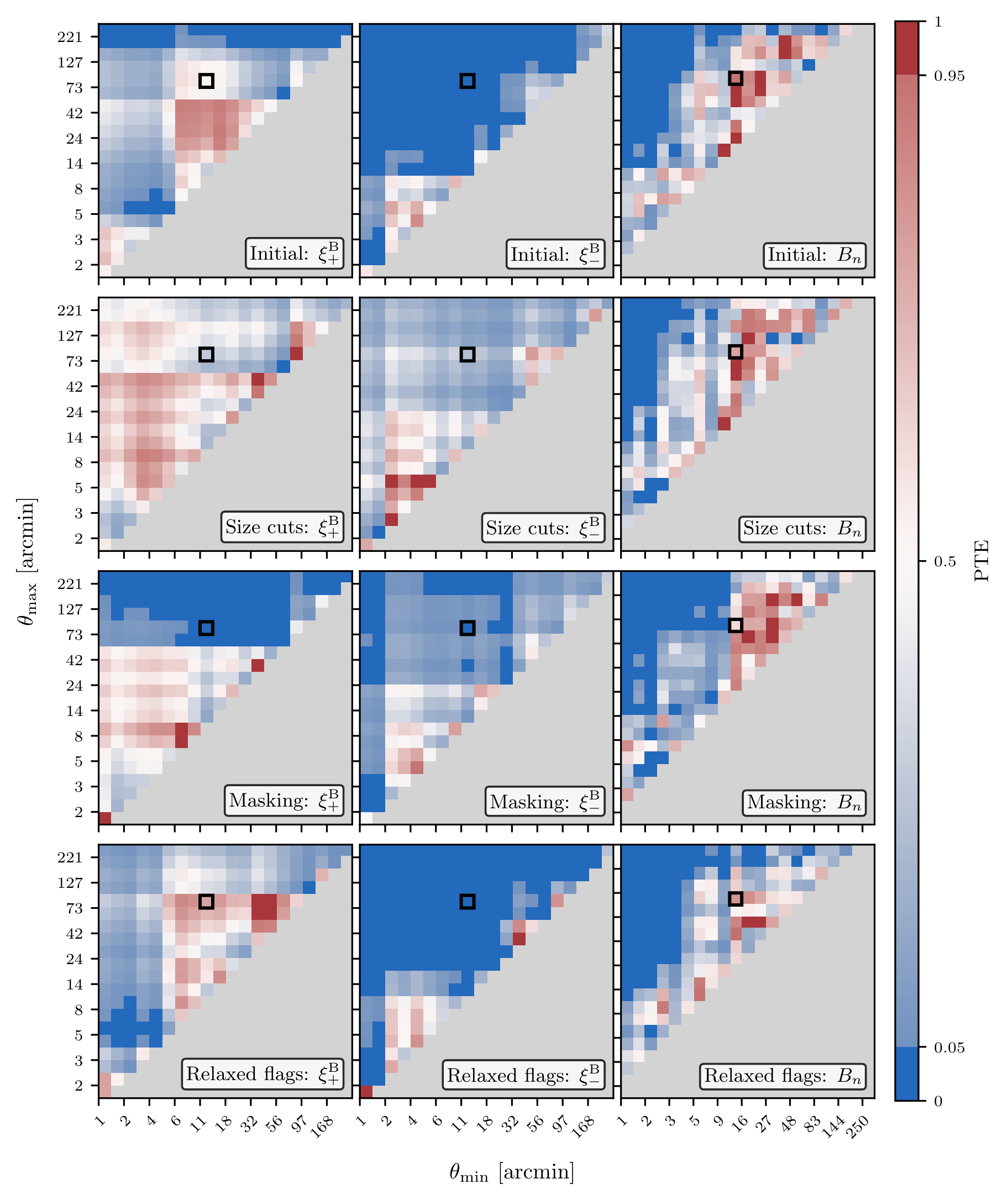
  • Rows — catalog versions:
    initial · fiducial · \(+\)masking · relaxed flags
  • Columns — statistics: \(\xi_+^B\), \(\xi_-^B\), COSEBI \(B_n\)
  • Color — PTE (blue \(\le 0.05\) fail, red \(\ge 0.95\))
  • Black squares — adopted cuts
  • The fiducial row is the only one where the adopted-cut square sits in a pass region across all three statistics

Covariance: semi-analytic + MC propagation

  • Harmonic-space (\(C_\ell^{BB}\), \(C_\ell^{EB}\)): Gaussian covariance from NaMaster’s iNKA framework
  • Configuration-space (pure-mode, COSEBIs): CosmoCov covariance of \(\xi_\pm\), propagated through the filter transforms
  • COSEBIs: linear transformation \(\mathbf{C}_{B_n B_m} = \mathbf{T}^{\mathsf{T}} \mathbf{C}_{\xi} \mathbf{T}\)
  • Pure-mode: 2000 MC realizations of \(\xi_\pm\), empirical covariance of the transformed data vector
  • All \(B\)-mode null tests use Gaussian-only covariance (conservative: no trispectrum, no super-sample terms)
  • Validated on 350 GLASS mocks [Tessore+23]: all three statistics recover \(B\) modes consistent with zero

COSEBI mock validation

  • 350 lognormal GLASS catalogs [Tessore+23] at Planck 2018 cosmology, UNIONS footprint + galaxy positions + weights
  • No PSF-related systematics — checks that the estimators don’t generate spurious \(B\) modes
  • COSEBIs: mean \(B_n\) biased by \(< 0.3\,\sigma\) per mode
  • Scatter comparable to fiducial error bars — uncertainty estimates of the right order