H₀ from gravitational-wave ×
galaxy cross-correlations
CosmoStat Journal Club
September 3, 2026
A chirping waveform gives \(d_L\) absolutely — but never \(z\)
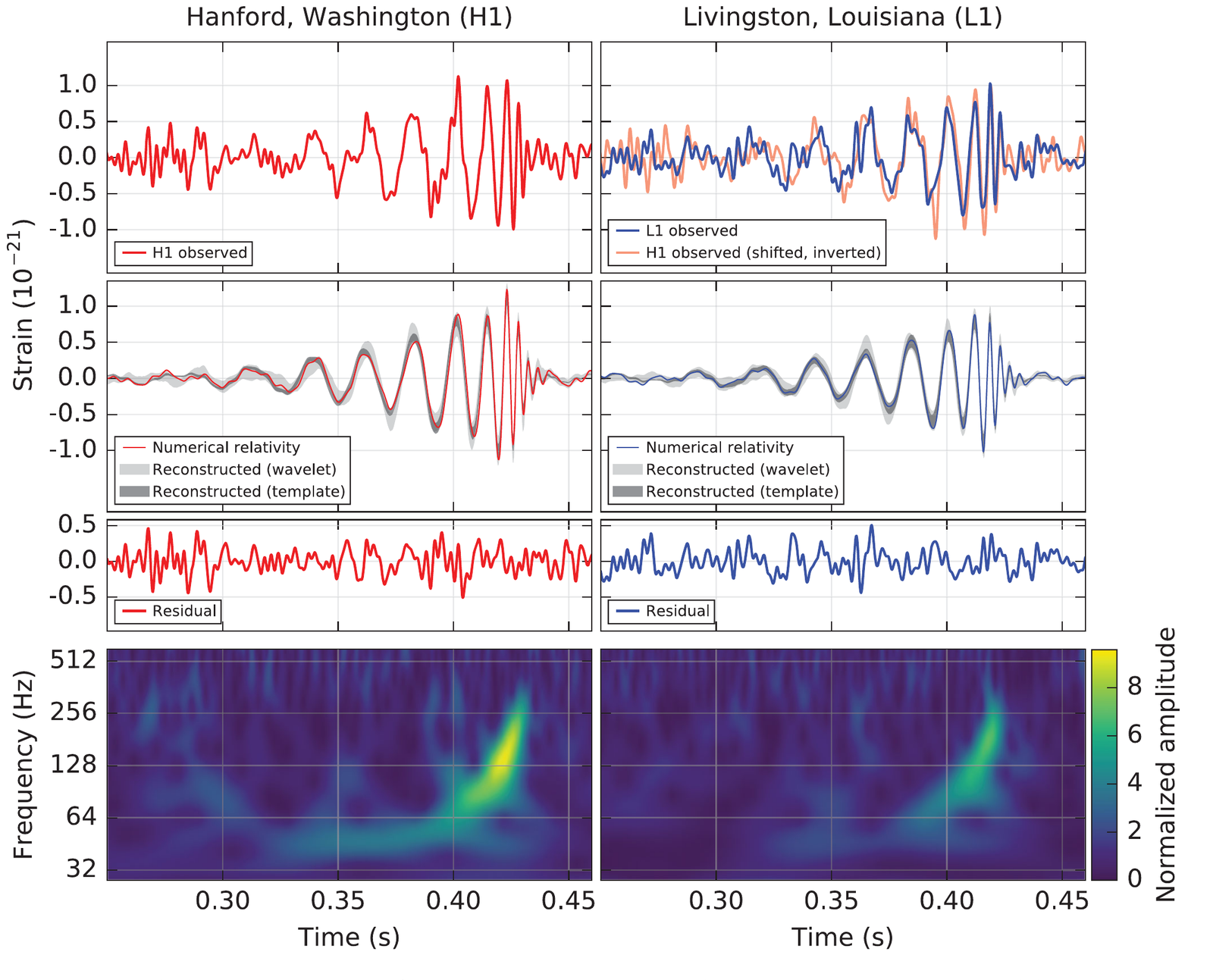
Amplitude alone is degenerate: \[h \;\propto\; \mathcal{M}_z^{5/3}\, f^{2/3}\,/\,d_L\]
Chirp rate breaks it — from phase, not amplitude: \[\dot f \;\propto\; \mathcal{M}_z^{5/3}\, f^{11/3} \;\;\Rightarrow\;\; \mathcal{M}_z\]
Plug \(\mathcal{M}_z\) back into \(h\) → \(d_L\) absolutely. GR-calibrated, no distance ladder.
What’s left: \(\mathcal{M}_z = (1+z)\,\mathcal{M}_\text{src}\). GW alone cannot separate mass from redshift → need external \(z\).
With a counterpart (bright) or without (dark)
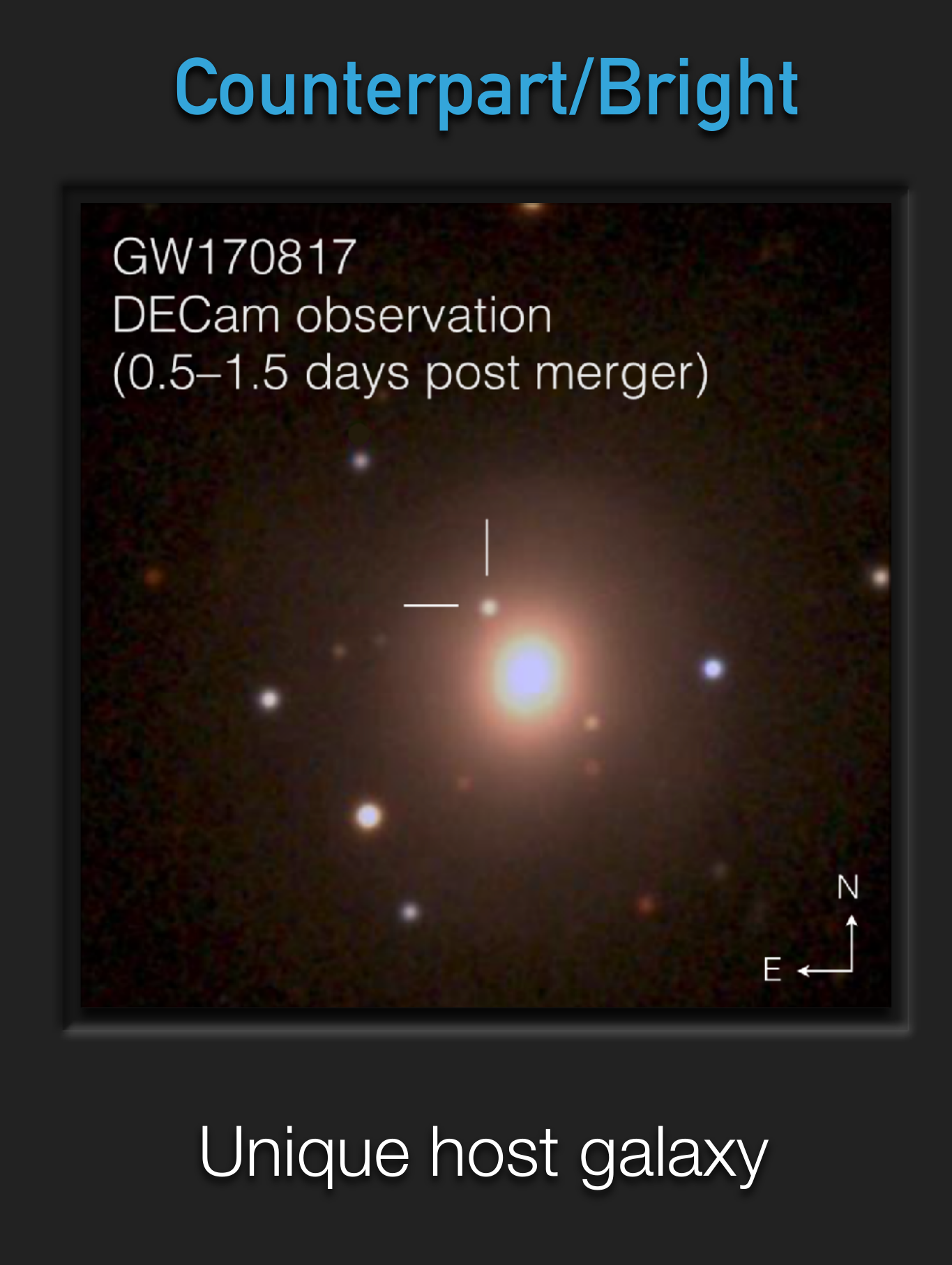
Bright — optical counterpart → host \(z\).
- GW170817: the one clean event so far, ~1 per few years.
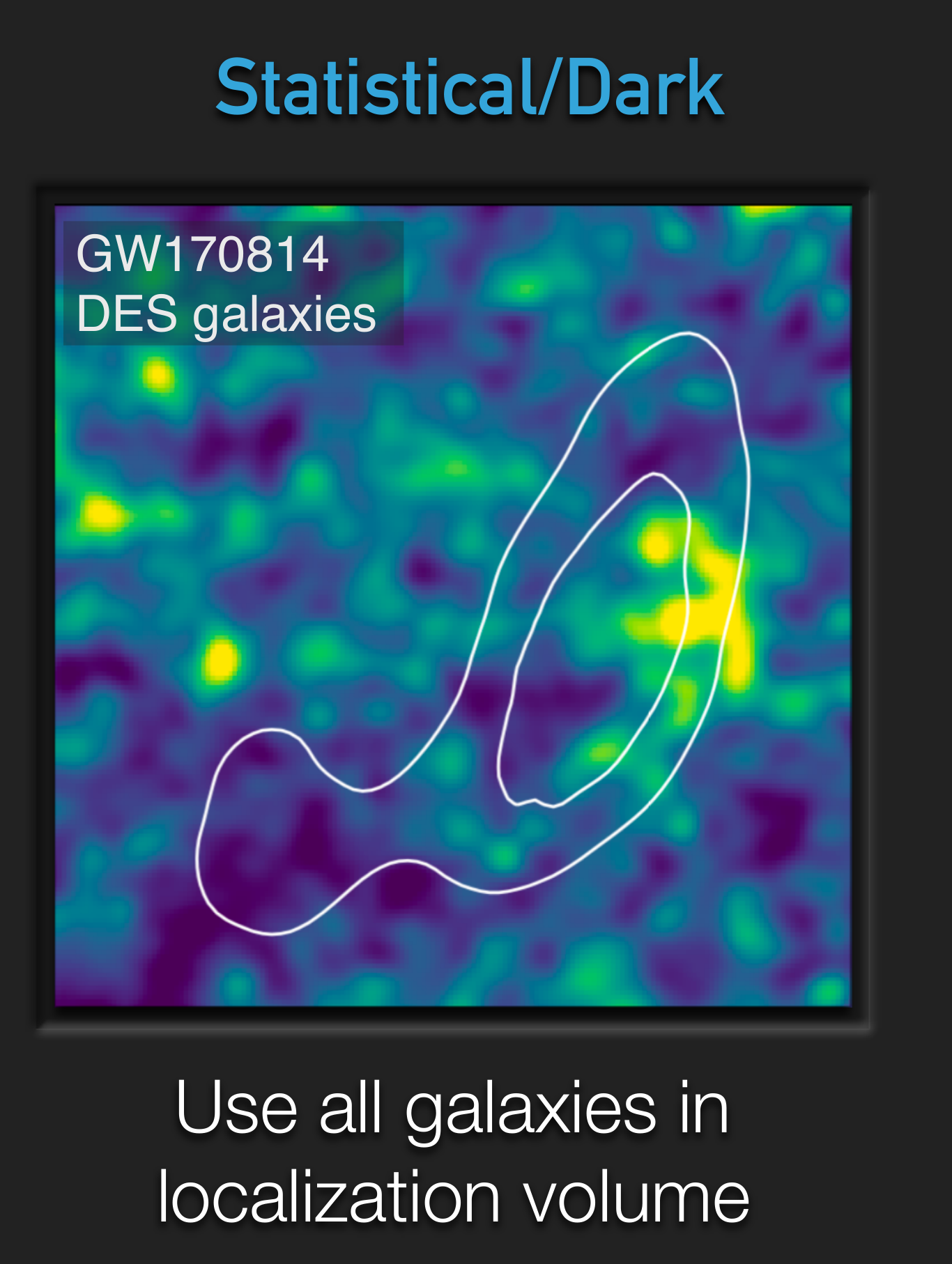
Dark — marginalize likelihood over every candidate host in the 3D localization volume.
- Systematic floor: galaxy-catalog (in)completeness.
Spectral sirens: hierarchical modeling of the observed mass distribution
Observed and source-frame mass distributions \(p(m_\text{obs})\) and \(p(m_\text{src})\) are linked by the redshift distribution of the sources: \[m_z \;=\; (1+z)\,m_\text{src}\]
\(p(m_\text{src})\) has features — power-law, peak near \(\sim\!35\,M_\odot\), second peak / dip (top right).
Hierarchical Bayesian fit on \((d_L, m_\text{obs})\) per event → joint posterior on \((H_0, \Omega_m, \pi_\text{pop})\).
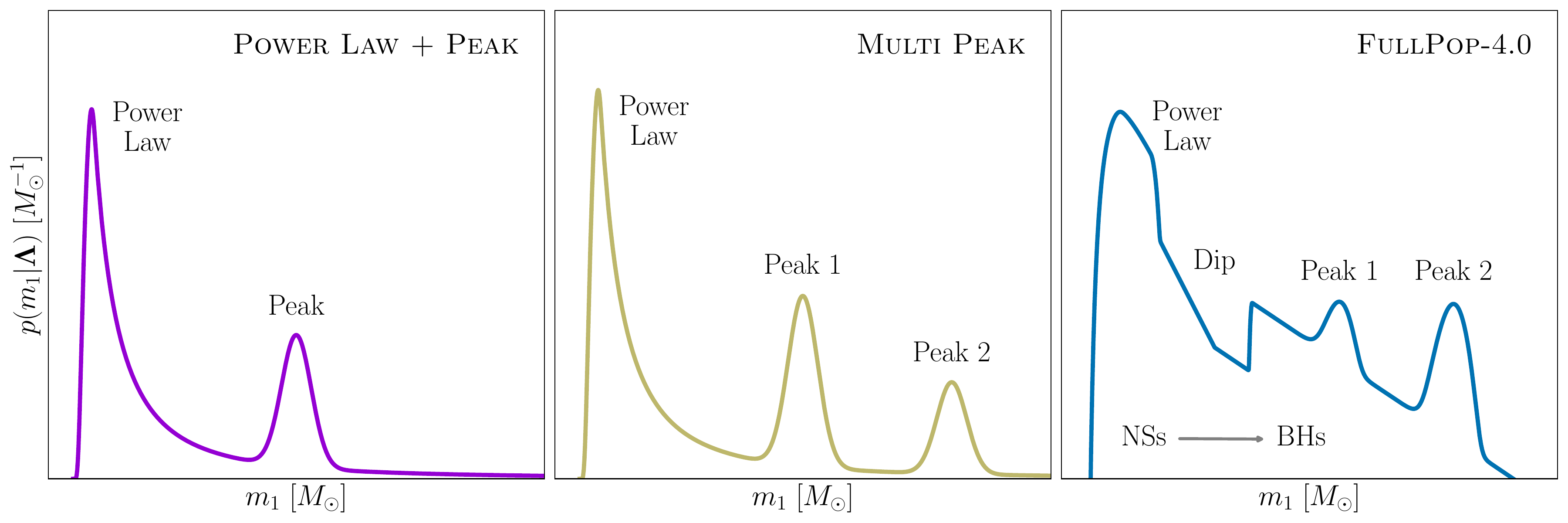
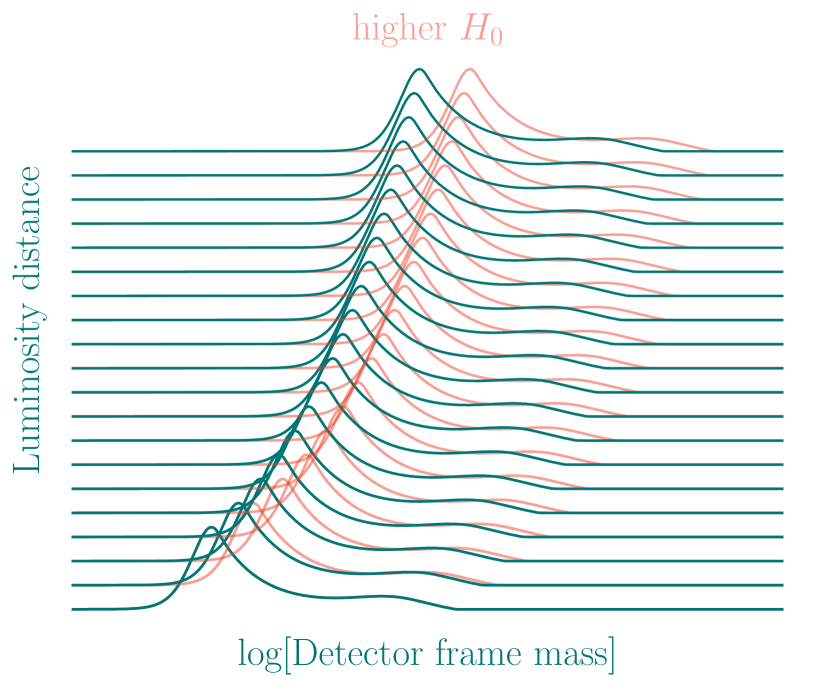
Top: LVK GWTC-4 cosmology (2509.04348) Fig. 1.
Bottom: Chen, Fishbach & Holz 2024 (2402.03120).
Method: Farr+ 2019.
Result: \(H_0 = 67.9^{+4.4}_{-4.3}\), driven by the 3×2pt \(\Omega_m\) prior
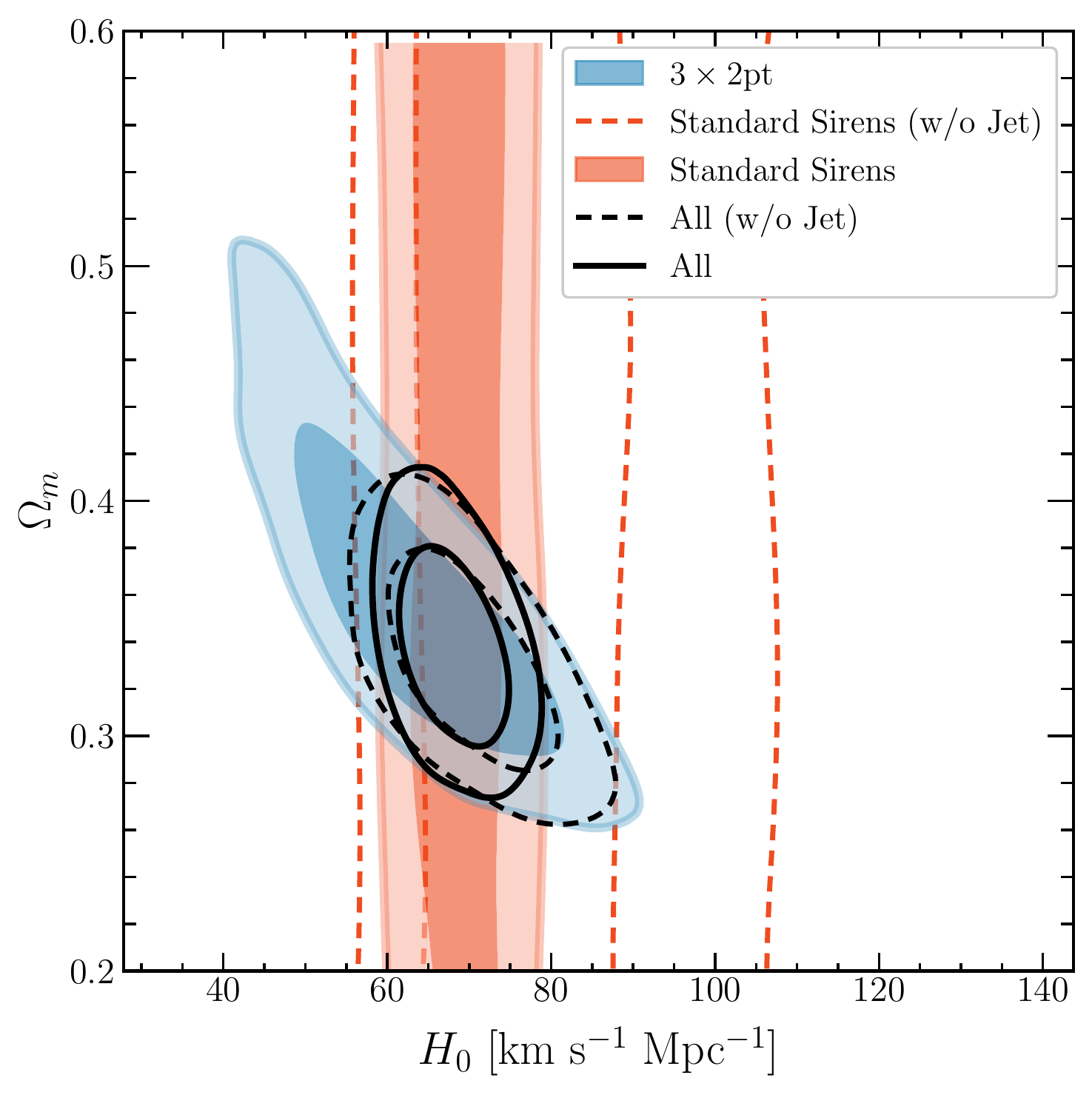
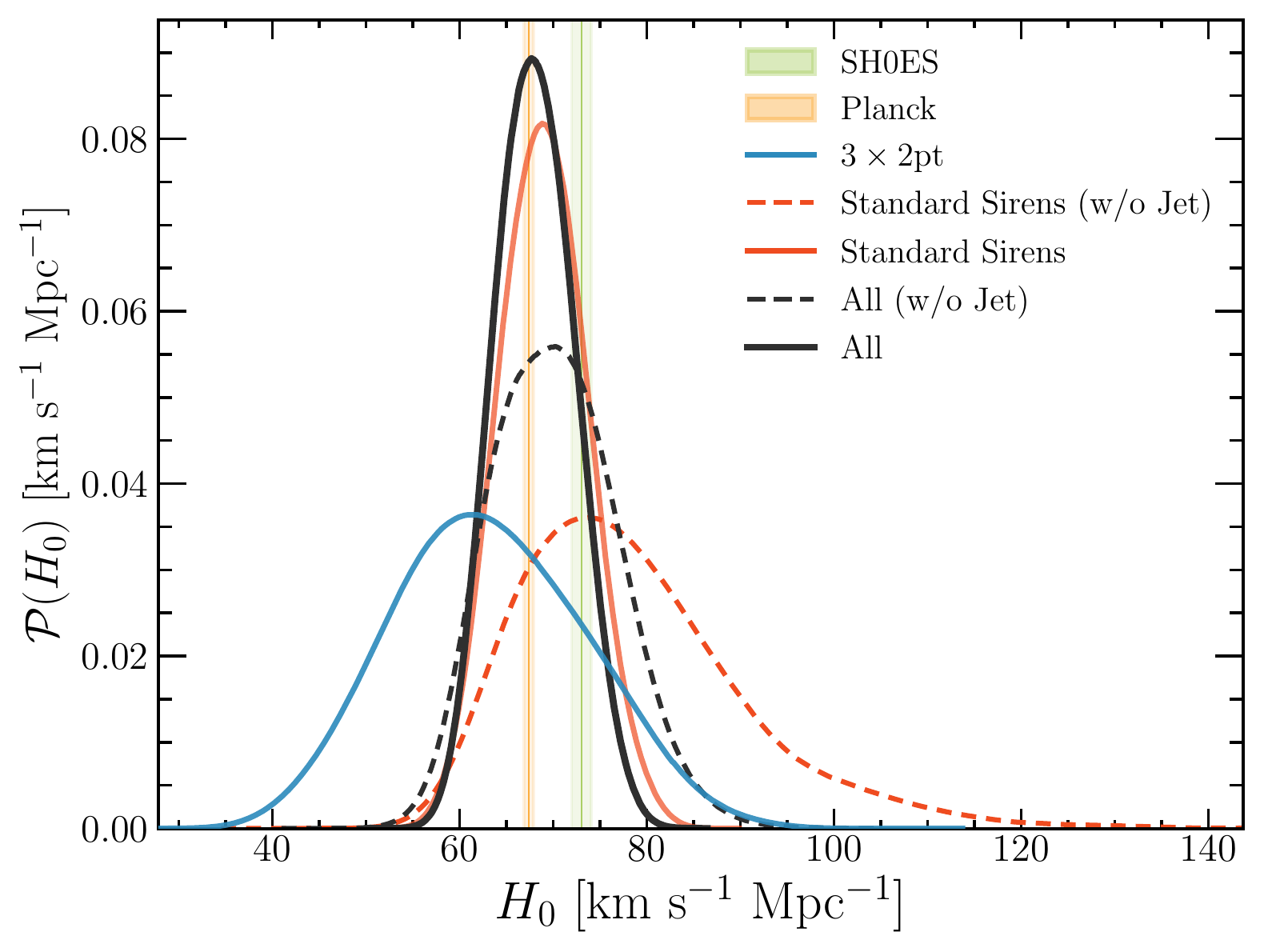
- Left: \((H_0, \Omega_m)\) 2D. 3×2pt (blue) × sirens (red) → tight joint contour (black).
- Right: 1D \(H_0\). “All” (black) is the 6.4% result, competitive with Planck/SH0ES width. \(\Omega_m\) improved 22% over DES-only.
Cross-correlation sirens: GW shell at \(d_L\) overlaps galaxy shell at \(z\) — only when \(H_0\) is right
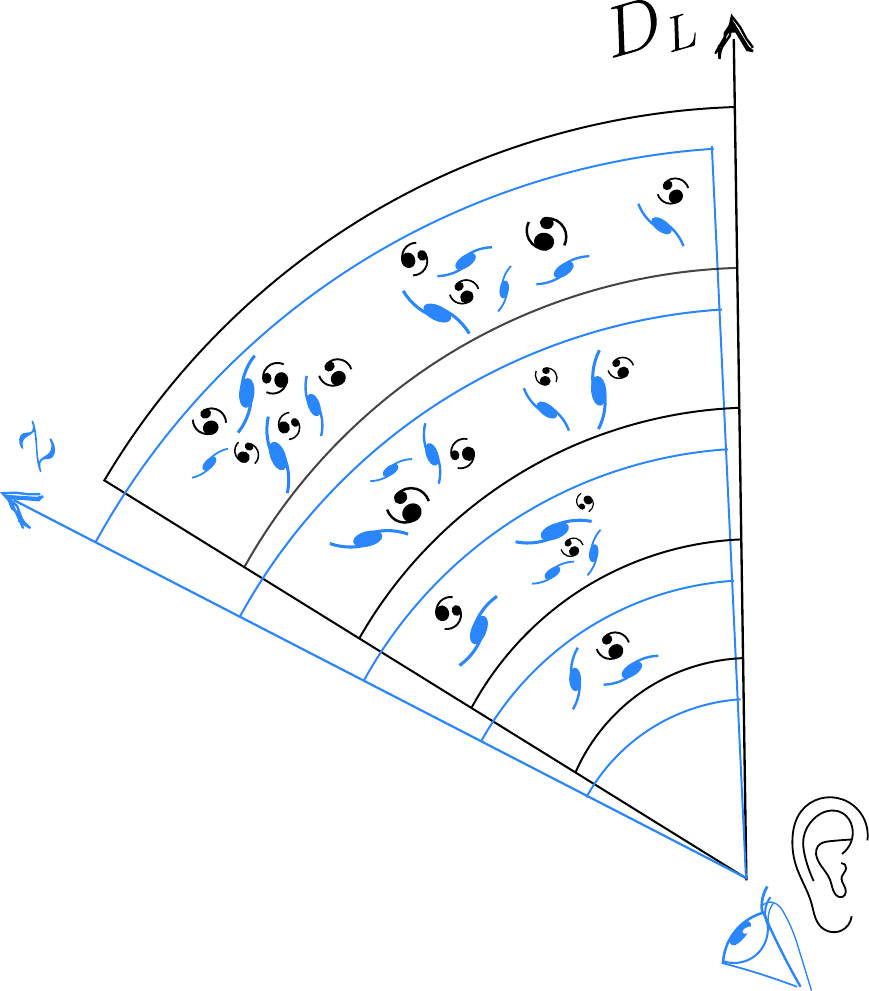
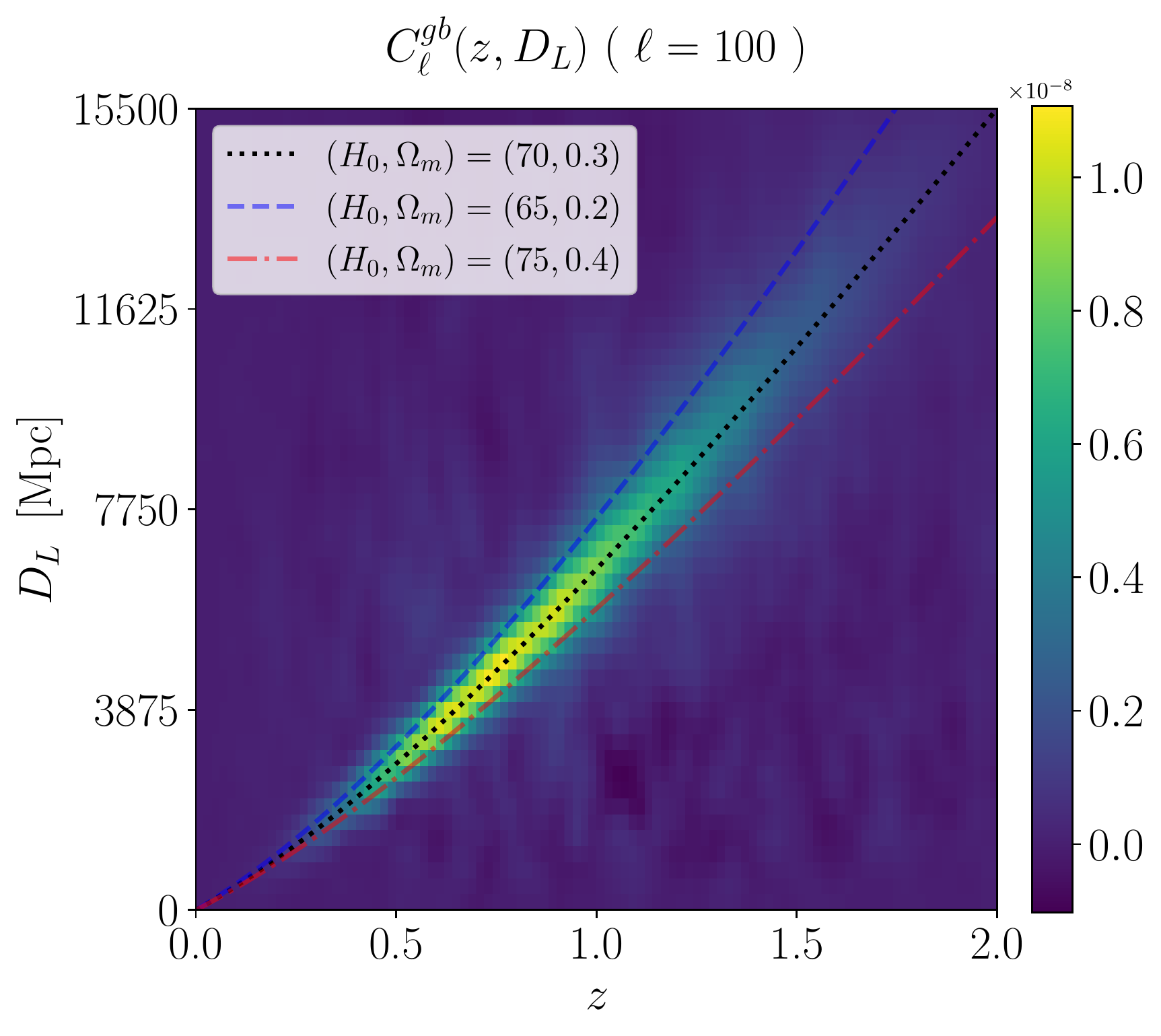
- 3D GW density field + galaxy field → cross-correlate. \(C_\ell^{gb}(z, d_L)\) peaks along the true \(d_L(z; H_0, \Omega_m)\); wrong \(H_0\) washes it out.
- No host ID: catalog incompleteness only enters through field statistics, much less sensitive.
Inside the simulation machinery
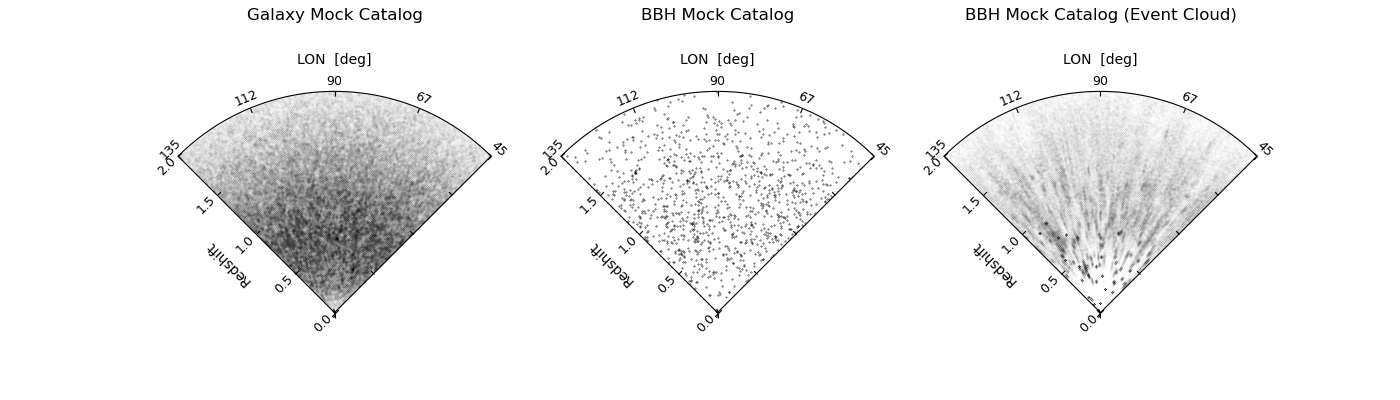
A galaxy–BBH mock catalog pair for the ET+2CE network, built with GLASS. Left: galaxies. Center: true BBH positions. Right: BBH “event clouds” after convolving with the per-event distance and sky-localization uncertainties.
First detection: 5.9σ GW × galaxy cross-correlation
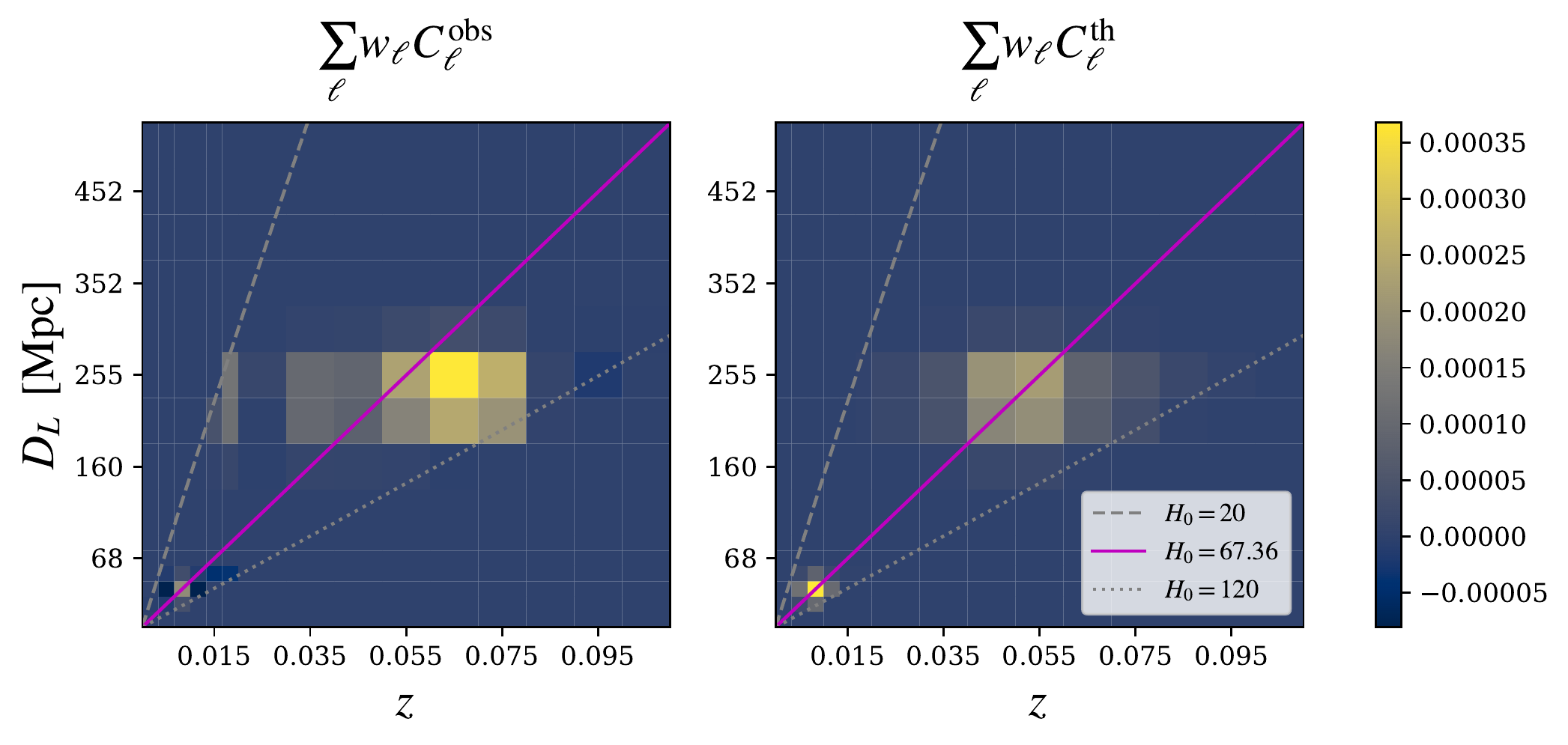
- GWTC-3.0 (90 events) × GLADE+ galaxy catalog
- Left: observed \(\sum_\ell w_\ell C_\ell^\text{obs}\) in \((z, d_L)\)
- Right: theory at \(H_0=67.36\) — match along the magenta line
Peak Sirens H₀ posterior: broad but detection is robust
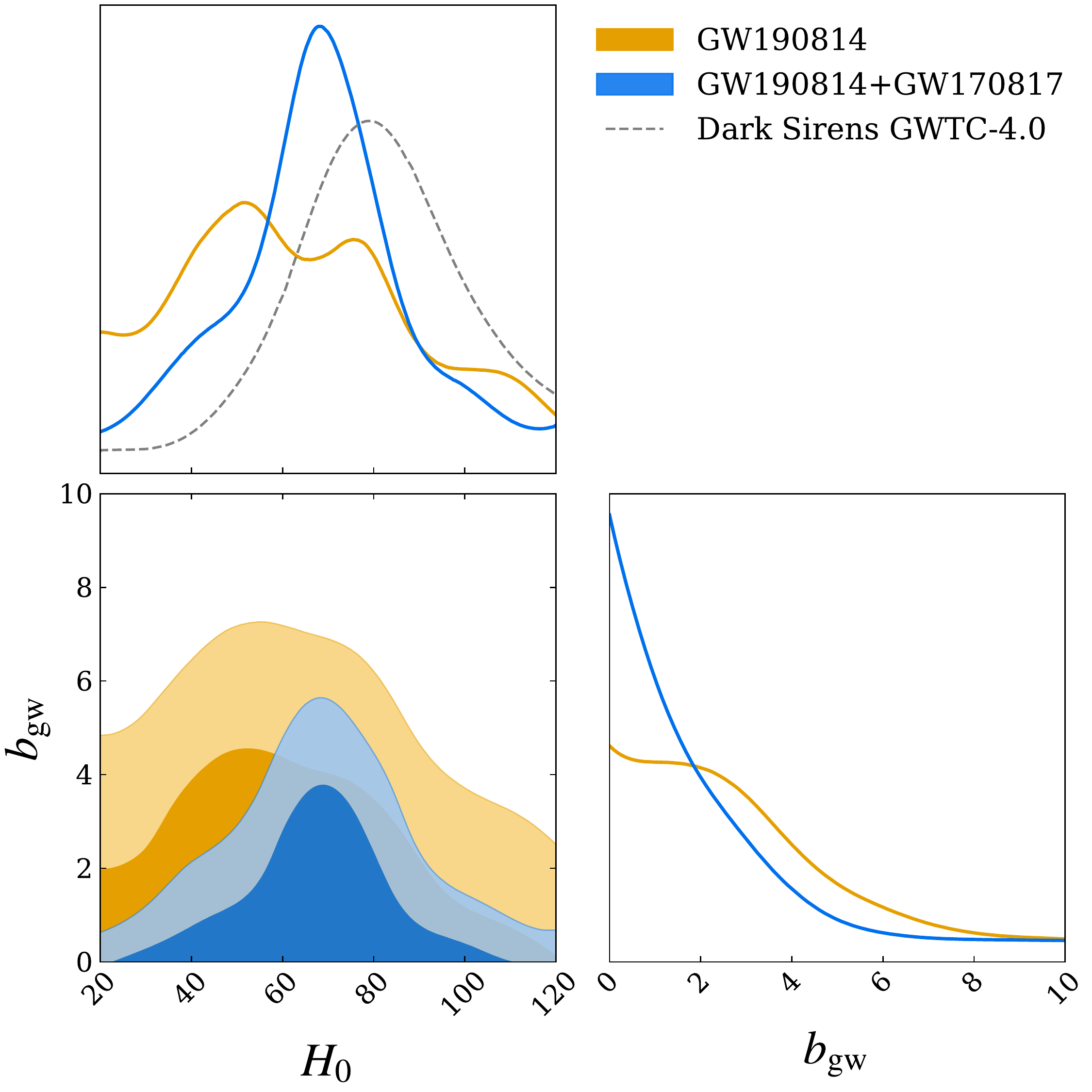
- Top: \(H_0\) marginal. With GW190814 bright bonus, peaks at 67.
- Bottom-right: \(b_\text{gw}\) marginal. Consistent with 0, constrained \(<4.3\).
- Contour: no degeneracy between \(H_0\) and \(b_\text{gw}\) — shape vs. amplitude.
- LVK dark-sirens posterior (gray, dashed) shown for comparison.
- \(H_0 = 67^{+18}_{-15}\) km/s/Mpc — wide, but first of its kind.
Weak-lensing magnification adds a tail at \(z_g < z_b\)
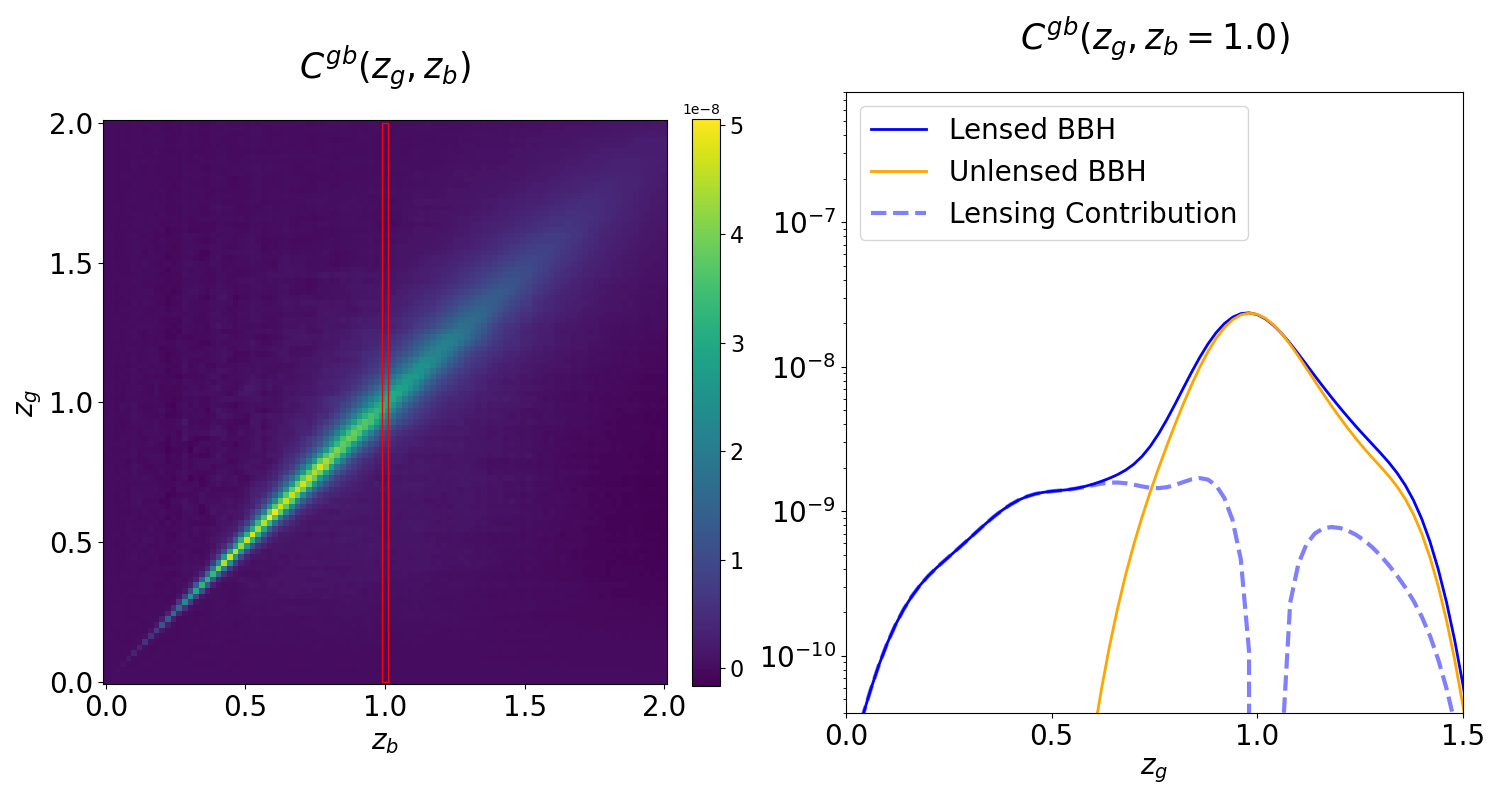
- GWs from distant BBHs are magnified by intervening structure → counted in foreground galaxy shells they didn’t actually inhabit.
- Lensing lifts the tail of \(C^{gb}(z_g, z_b)\) at \(z_g < z_b\) (right panel, dashed blue).
- Peak is only slightly shifted → method is robust for LVK/O5, but next-gen precision will require modeling it.
Next-gen detectors push \(H_0\) into the sub-% regime
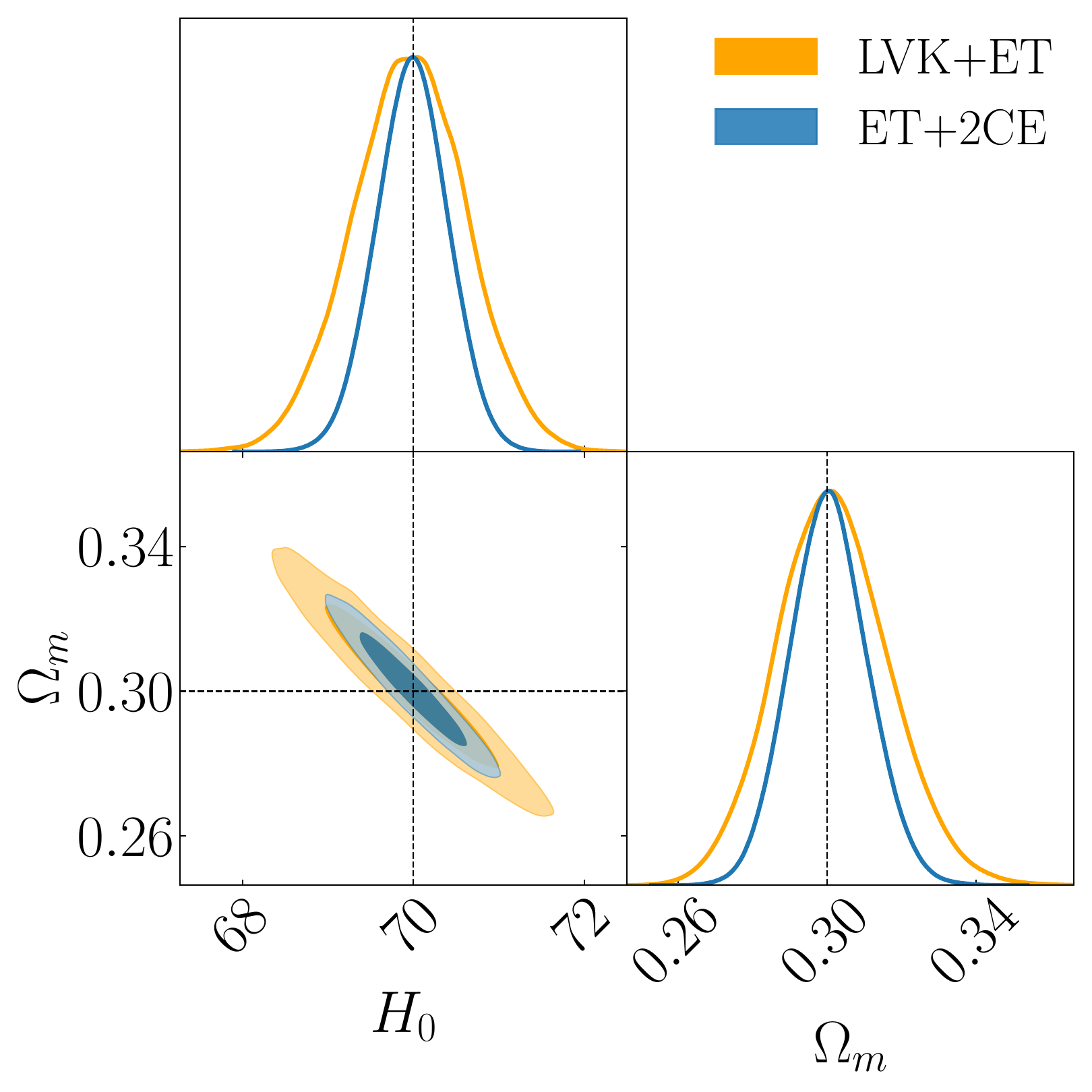
Ferri+ 2025 forecasts (ΛCDM, joint \((H_0, \Omega_m)\)):
| network | \(\sigma(H_0)/H_0\) |
|---|---|
| LVK O5 | 4% (with external \(\Omega_m\)) |
| LVK + ET | ~1% |
| ET + 2CE | ~0.6% |
- Adding one next-generation detector (e.g. ET alone) gives an order-of-magnitude improvement in both \(H_0\) and \(\Omega_m\).
- Competitive \(w_0 w_a\) constraints from the same data.
Q: what redshifts are the GWTC-3 events actually at?
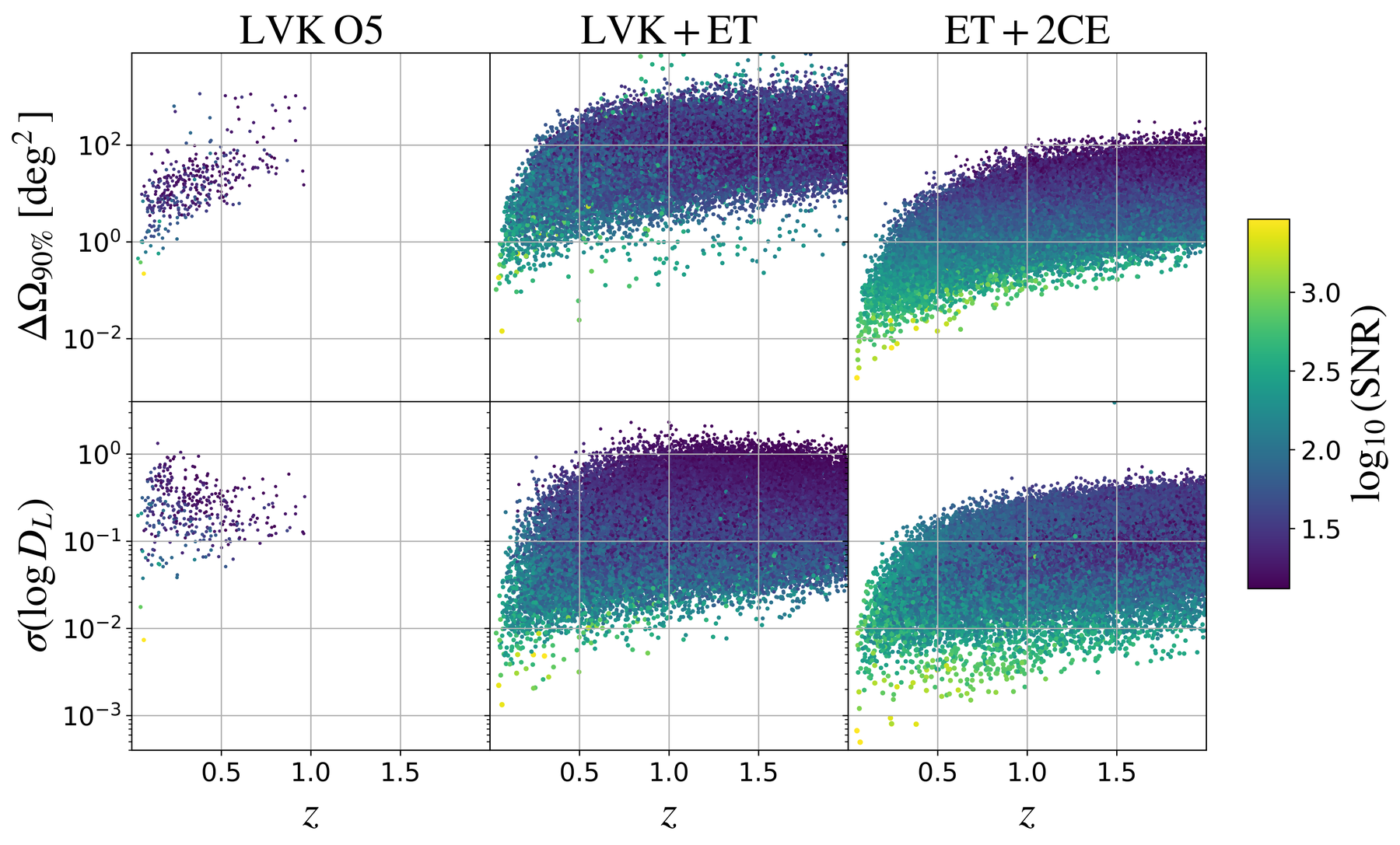
- LVK O5 forecast BBHs live almost entirely at \(z \lesssim 1\), concentrated in \(z \sim 0.1\text{--}0.5\).
- GWTC-3 (what Peak Sirens actually uses) is tighter still — most events at \(z \lesssim 0.3\).
- 3G pushes the accessible range to \(z \sim 2\) in the cross-correlation analysis (even though ET alone detects BBHs to \(z \sim 10\)).