UNIONS-3500:
First Cosmological Constraints
from 2D Cosmic Shear
Rencontres de Moriond — Cosmology
March 27, 2026



Cosmic shear benefits from independent measurements
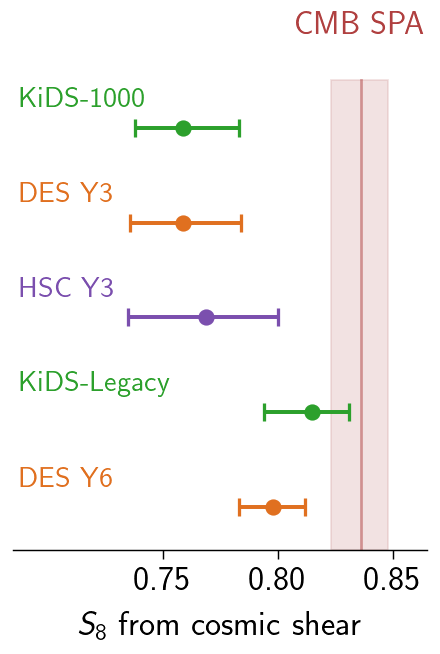
- \(S_8\) seems to be converging as systematics improve; consensus is important!
- \(S_8\) seems to be converging as systematics improve; consensus is important!
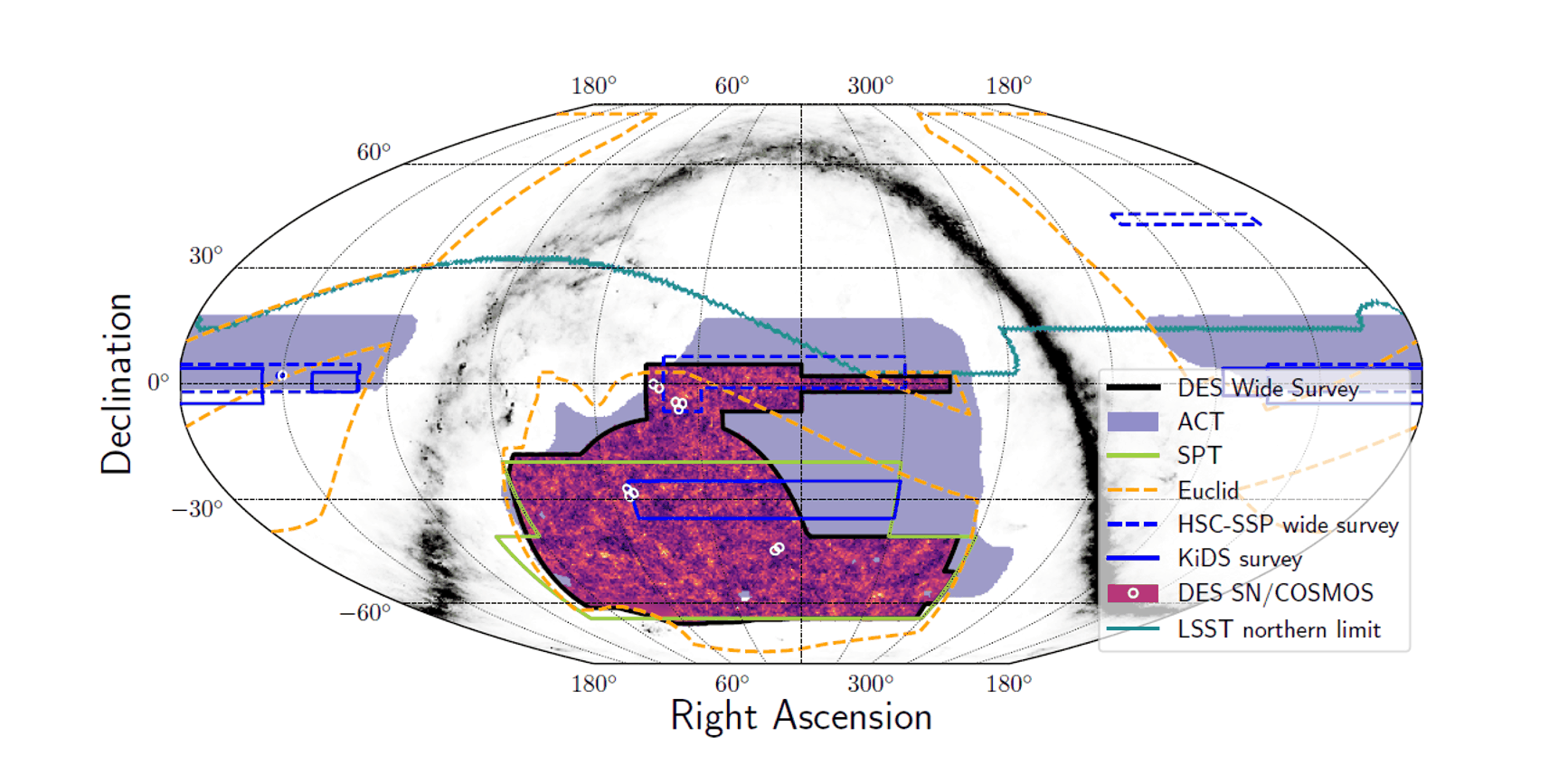
- But the northern sky has no wide-field lensing surveys
UNIONS adds deep wide-field lensing constraints in the North
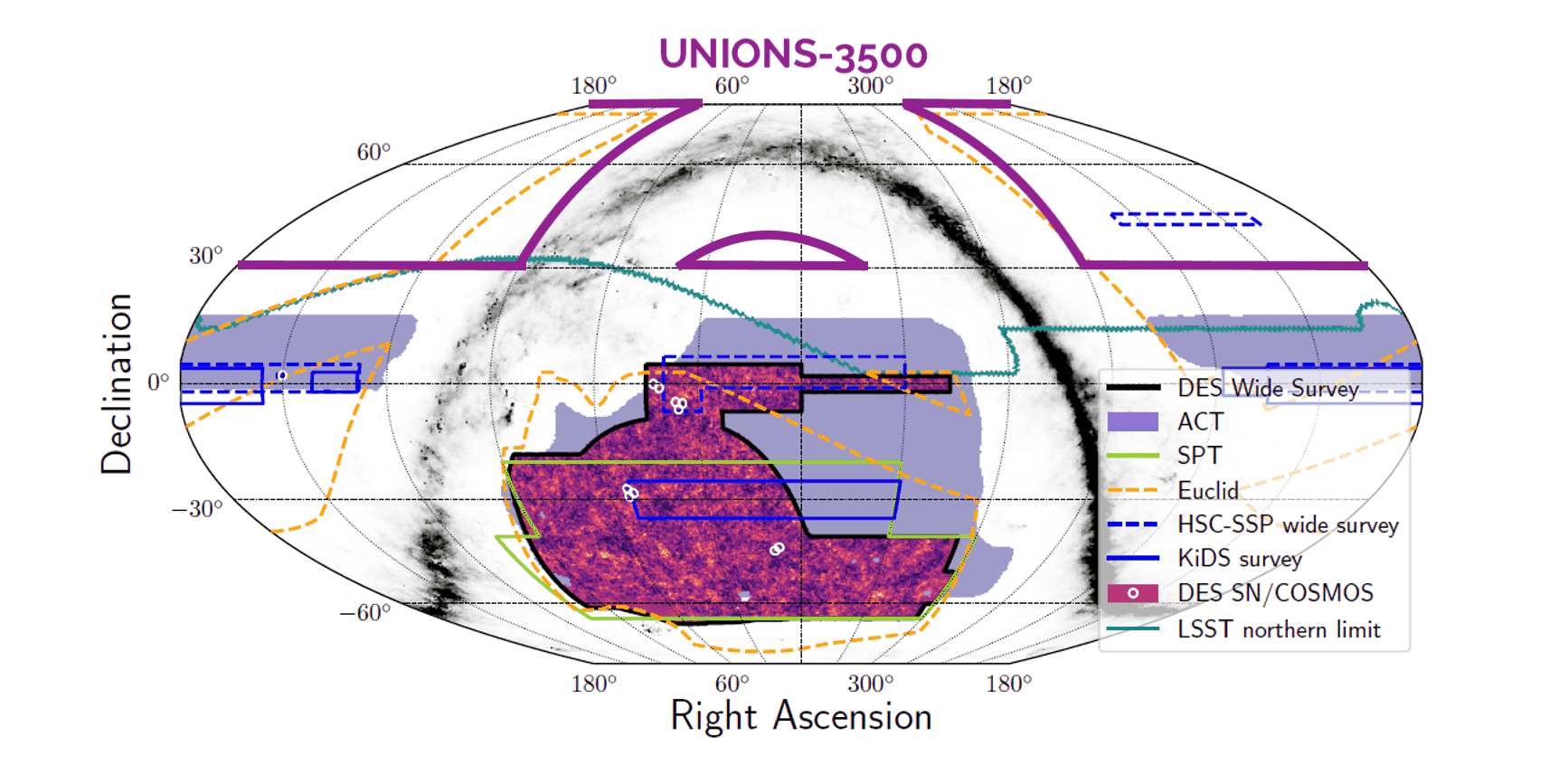
- Different instrument, on-sky systematics, sample variance
- New cross-correlation opportunities (DESI, Planck, BOSS)
The 2D cosmic shear team
Core members in alphabetical order (many others have contributed over the years):

(redshift estimation)

(B-modes, covariance,
masking)

(catalog validation,
systematics)

(catalog, image
simulations)

(inference, covariance,
masking)

(catalog, wisdom)

(inference, PSF
systematics)
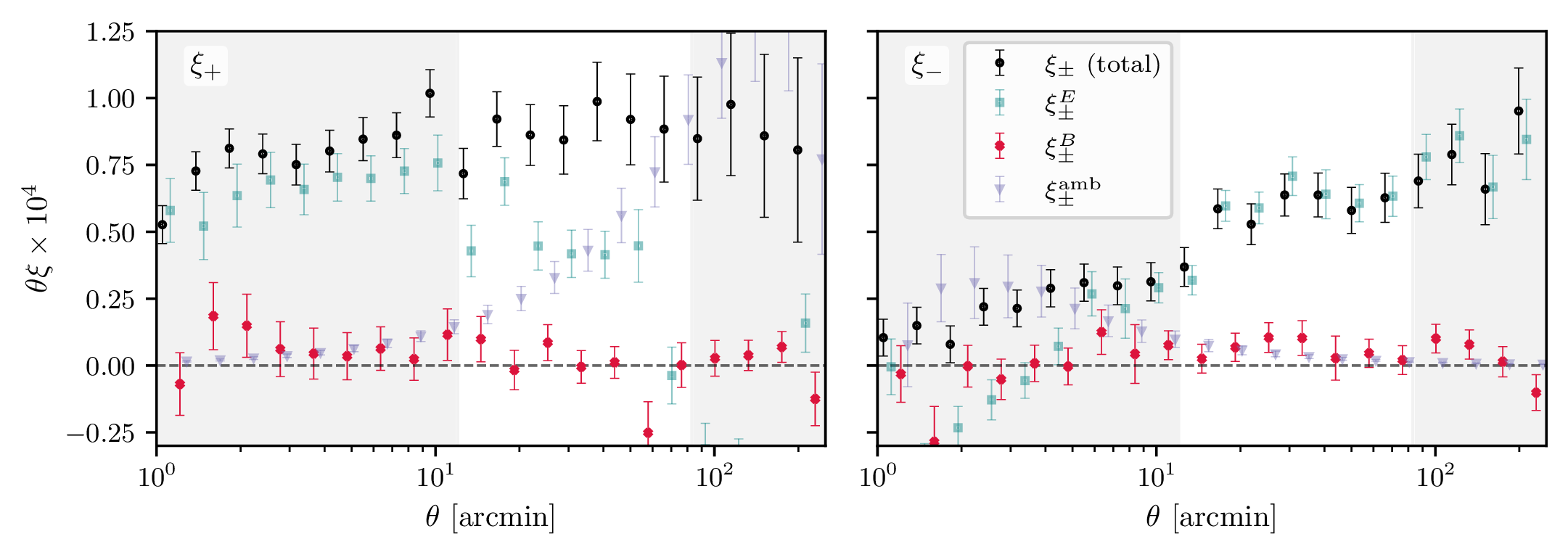
Paper III uses B-mode estimators to characterize systematics
- To leading order, B-modes serve as a systematics null test
- Synthesize \(\xi_\pm^B\), COSEBIs, and \(C_\ell\) statistics to inform scale cuts and sample selection
Paper IV jointly fits cosmology and PSF leakage in real space
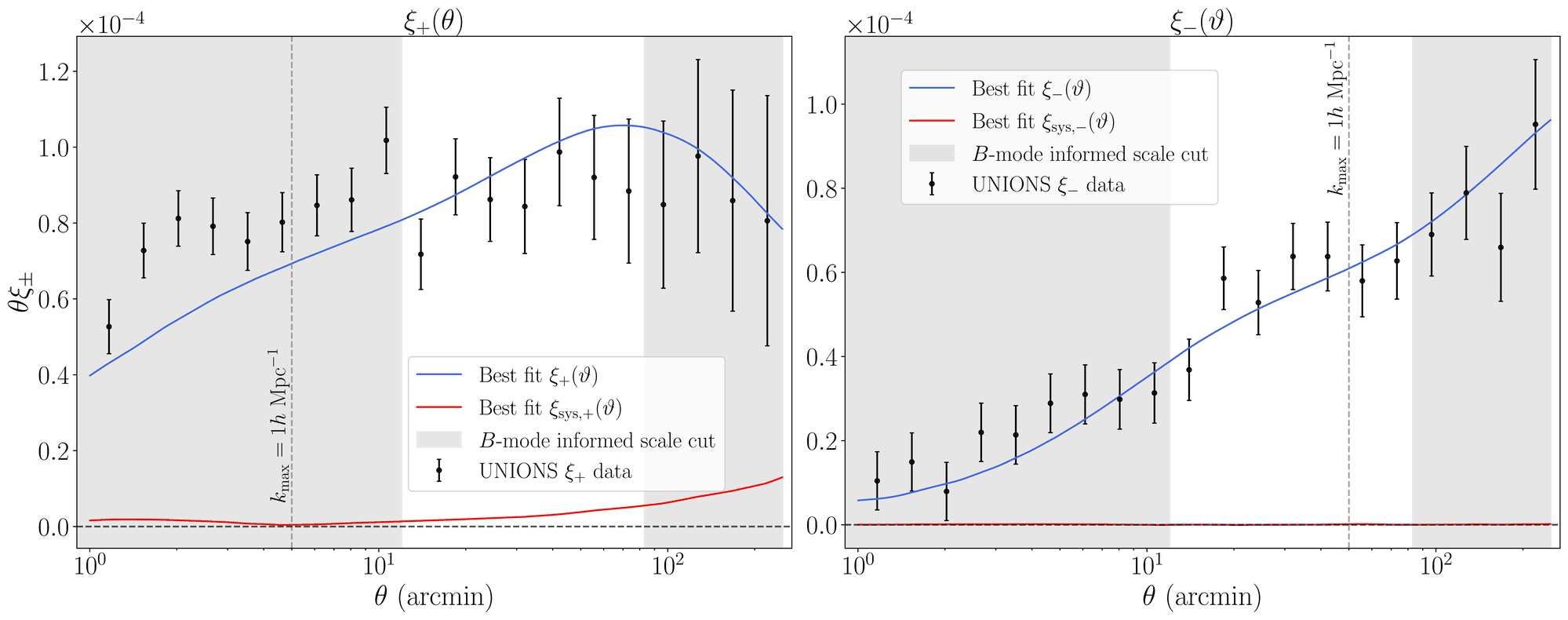
\(\xi_\pm(\theta)\) with best-fit model and leakage systematics
Paper V provides harmonic-space constraints from the same data
- Same catalog, \(n(z)\), and blinding, but different basis and weighting of scales
All analysis choices fixed before unblinding
- Blind by modifying \(n(z)\): three realizations A/B/C, one unshifted
- Catalog version, scale cuts, and robustness criteria frozen before collaboration-wide unblinding
- Caveat: cosmology-paper authors were inadvertently unblinded ~2 weeks before. No analysis choices changed after this point
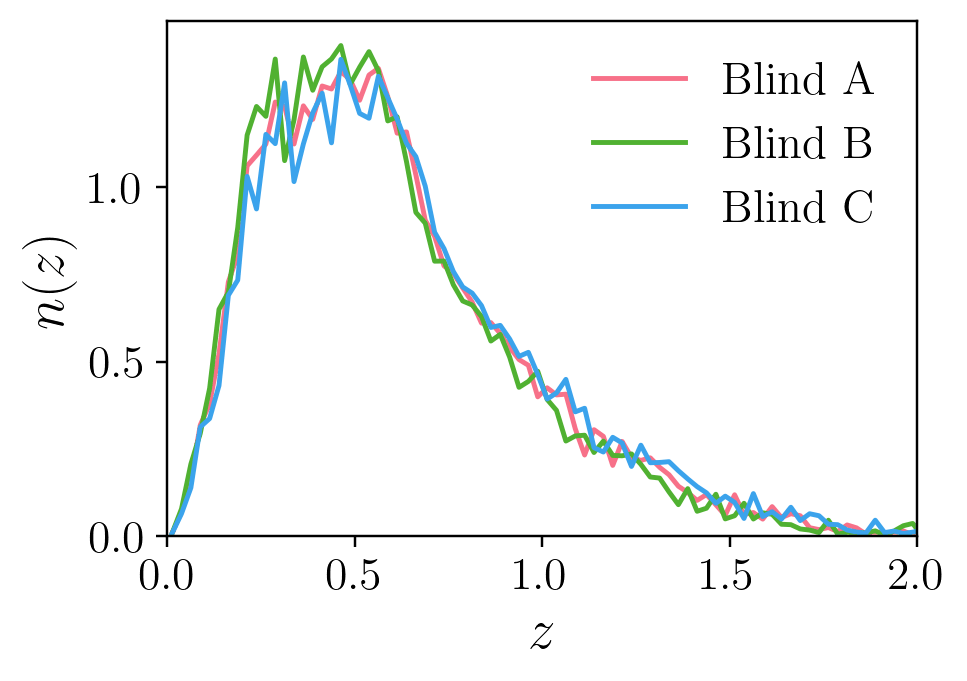
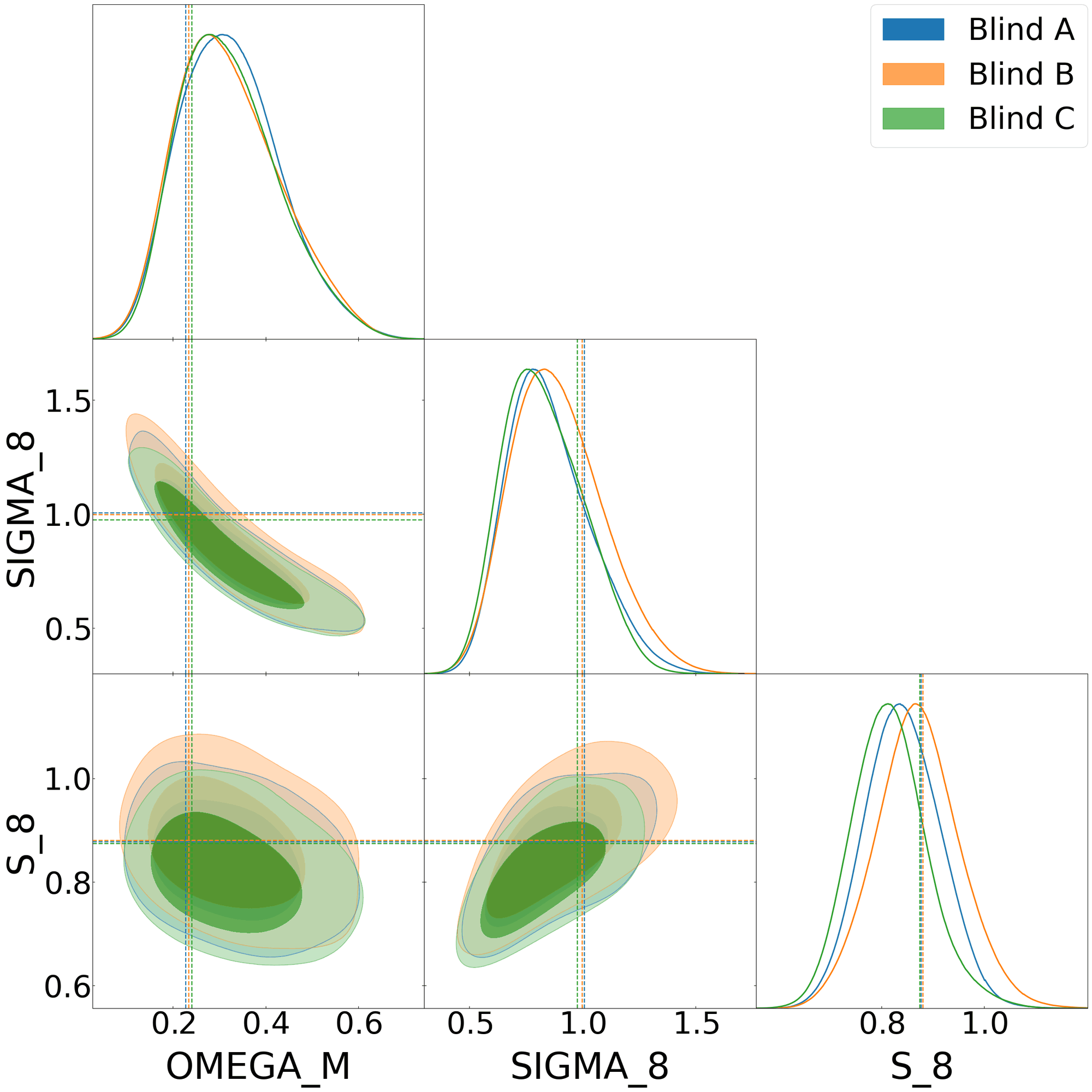
Three redshift blinds used in this analysis. B turned out to be real.
Different B-mode statistics do not always agree
- Over the full range (\(1\)–\(250'\), \(\ell \lesssim 2000\)): \(\xi_\pm^B\) and \(C_\ell^{BB}\) pass, but COSEBIs fail
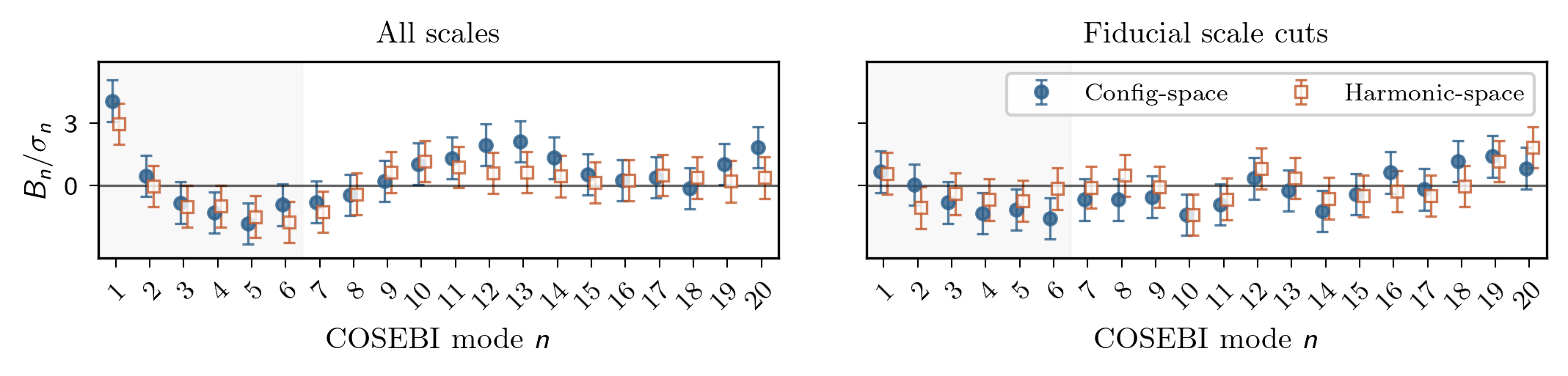
- Each statistic weights scales differently; we require all three to pass
- Not able to decisively identify the origin of these B-modes
Sample selection and scale cuts informed by B-mode tests
-
Scale cuts informed by B-mode PTEs, PSF leakage, and blinded \(S_8\) dependence
(Papers IV/V) -
Adopted cuts: \([12, 83]'\), \(\ell = 300\)–\(1600\)
(\(k_\mathrm{max} \approx 2.6\;h\,\mathrm{Mpc}^{-1}\)); all PTEs \(> 0.18\)
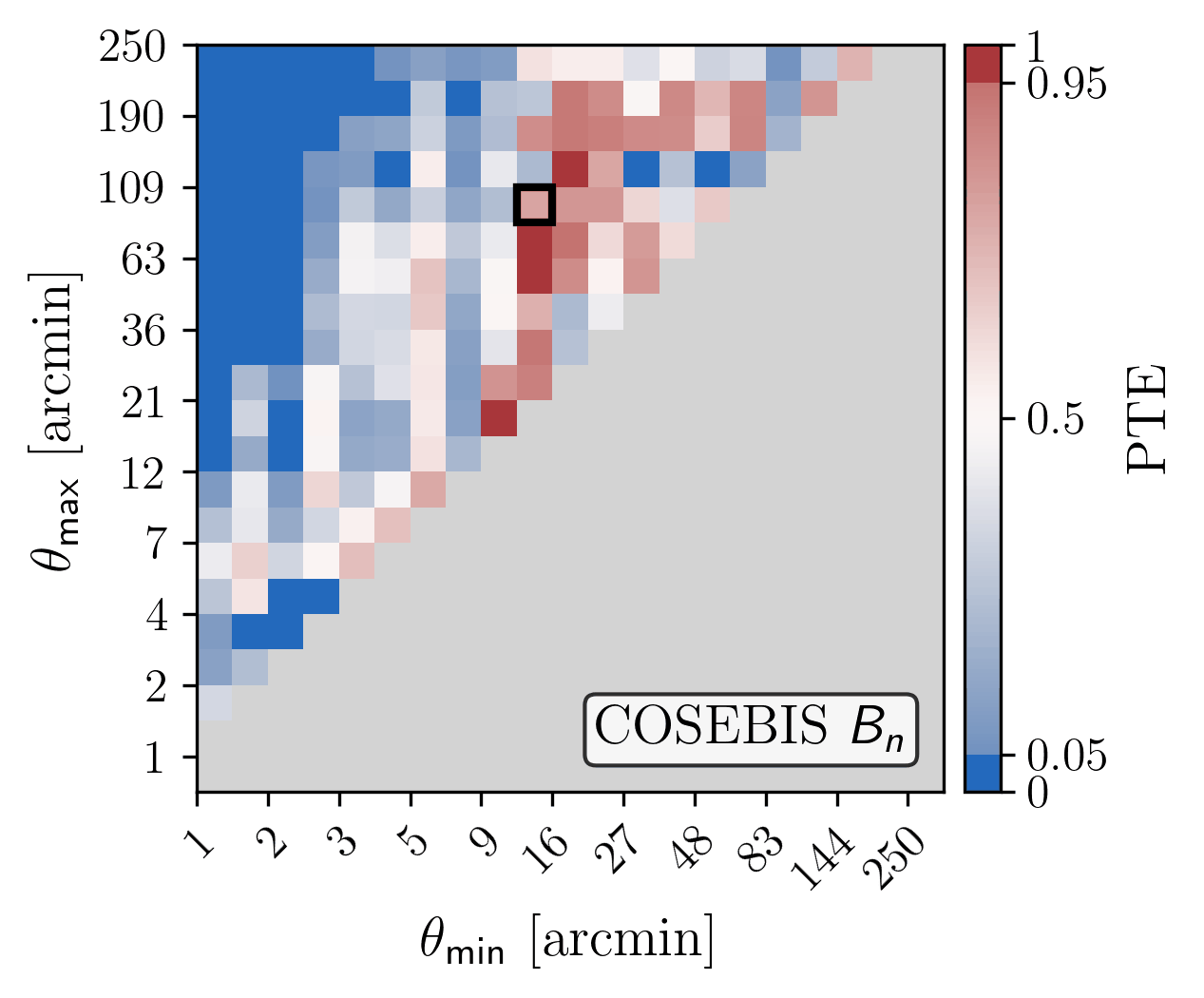
COSEBIS PTEs as a function of lower and upper scale cut. Square: adopted cuts.
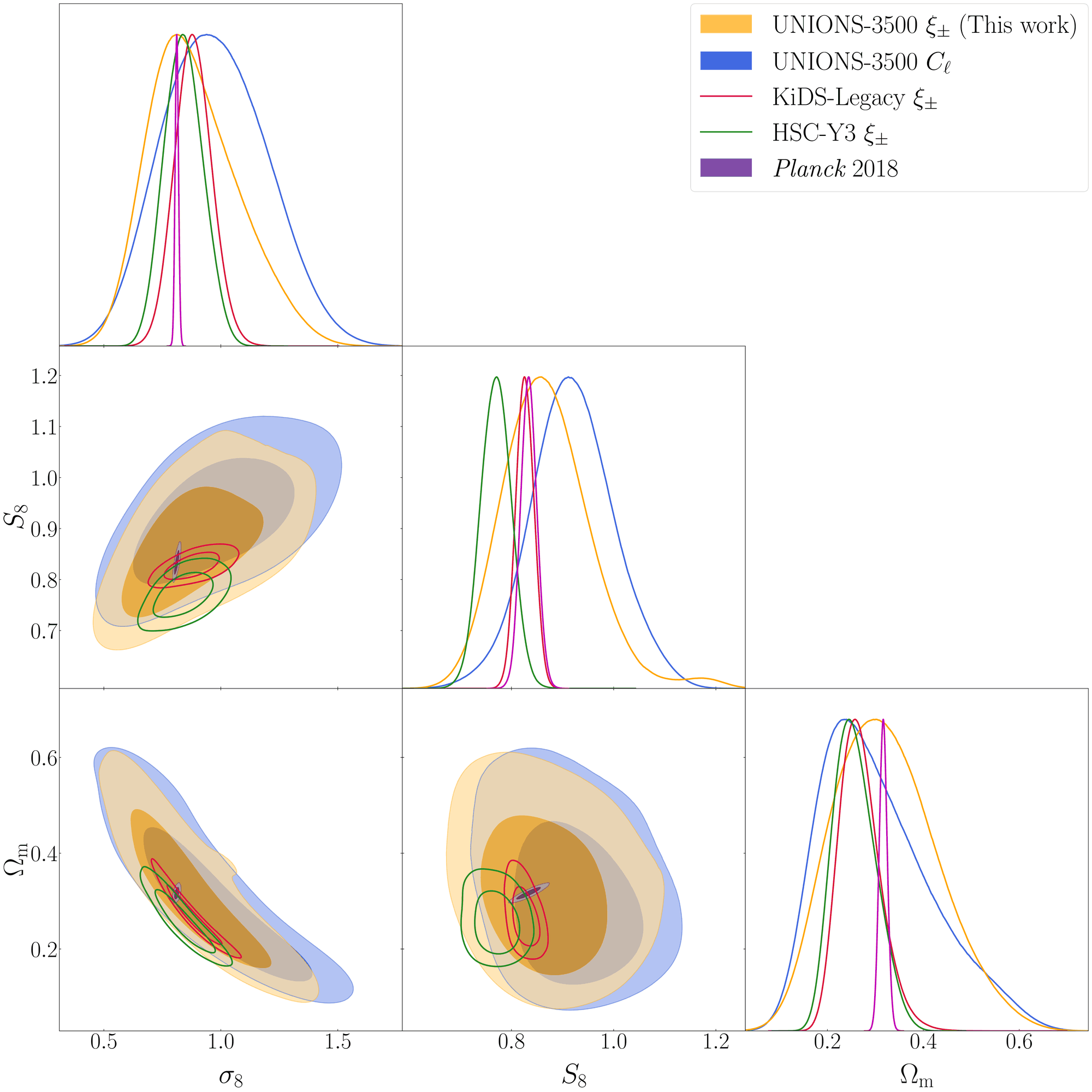
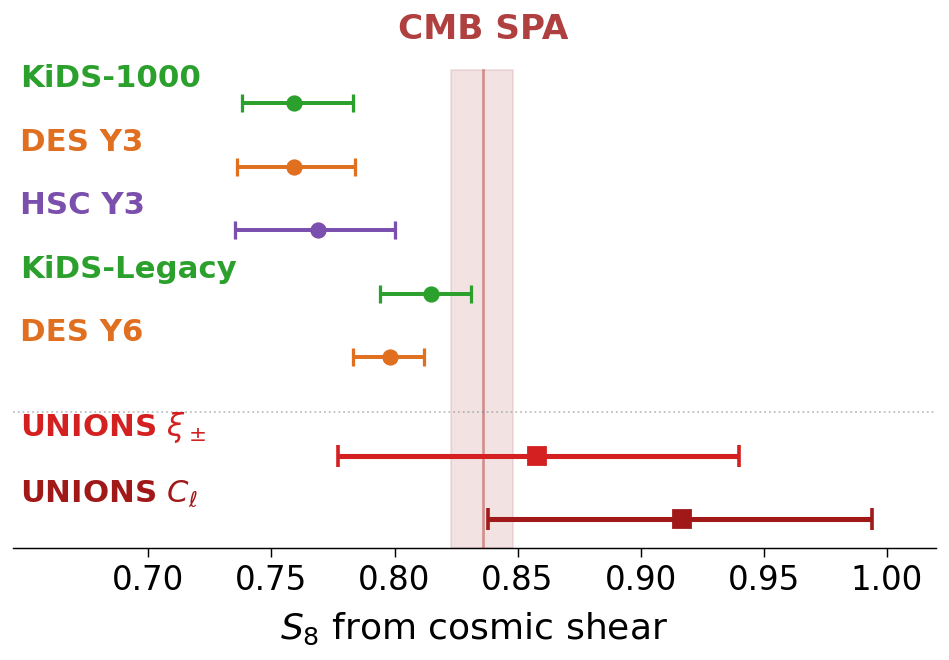
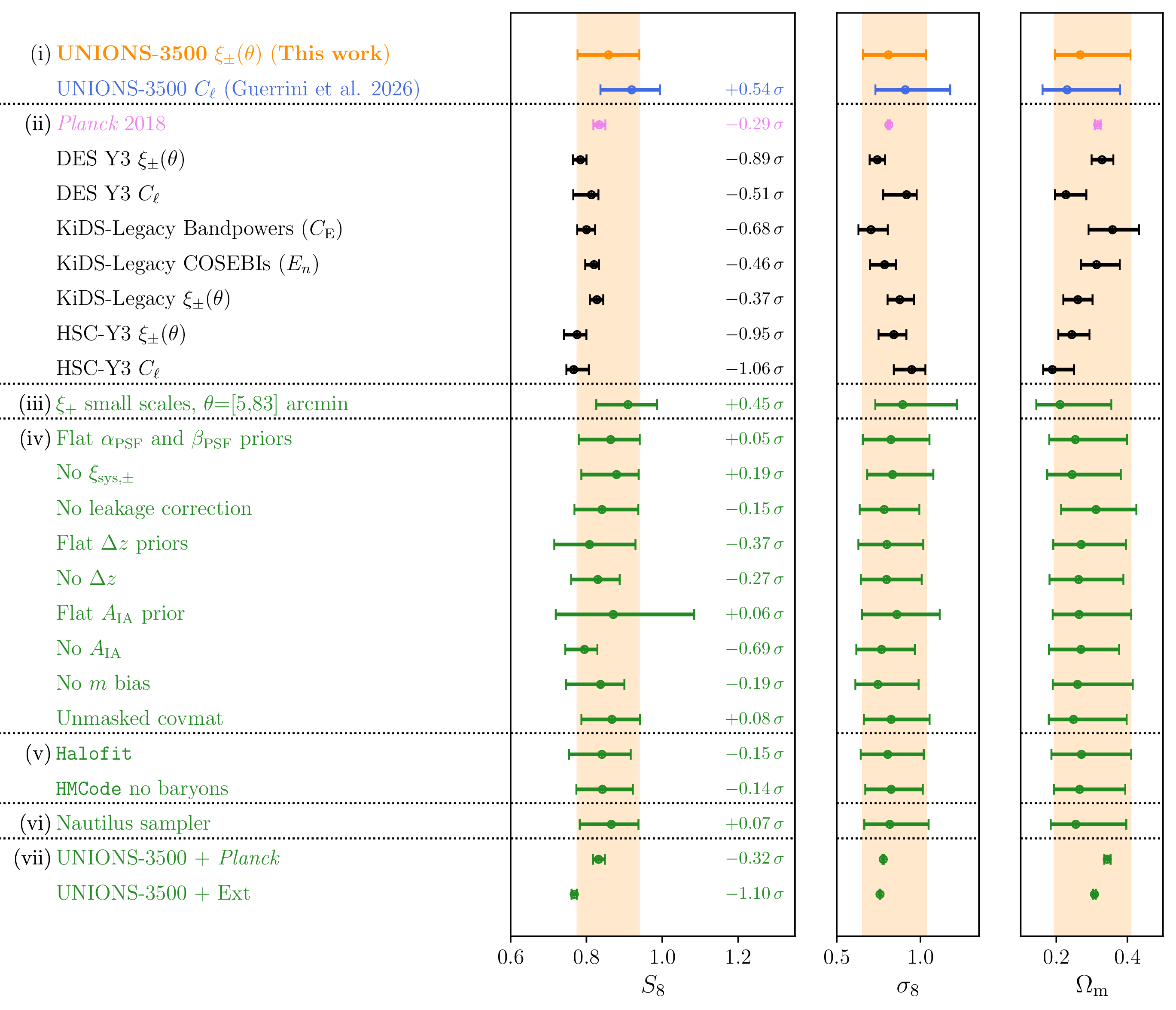
UNIONS constraints agree with Planck and Stage III at ~1σ
| \(S_8\) | \(\Omega_m\) | |
|---|---|---|
| \(\xi_\pm\) | \(0.86 \pm 0.08\) | \(0.27^{+0.14}_{-0.07}\) |
| \(C_\ell\) | \(0.92 \pm 0.08\) | \(0.22^{+0.18}_{-0.06}\) |
\(S_8\) is robust to analysis choices
but sensitive to the IA prior
- Most robustness tests shift \(S_8\) by \(< 0.4\sigma\)
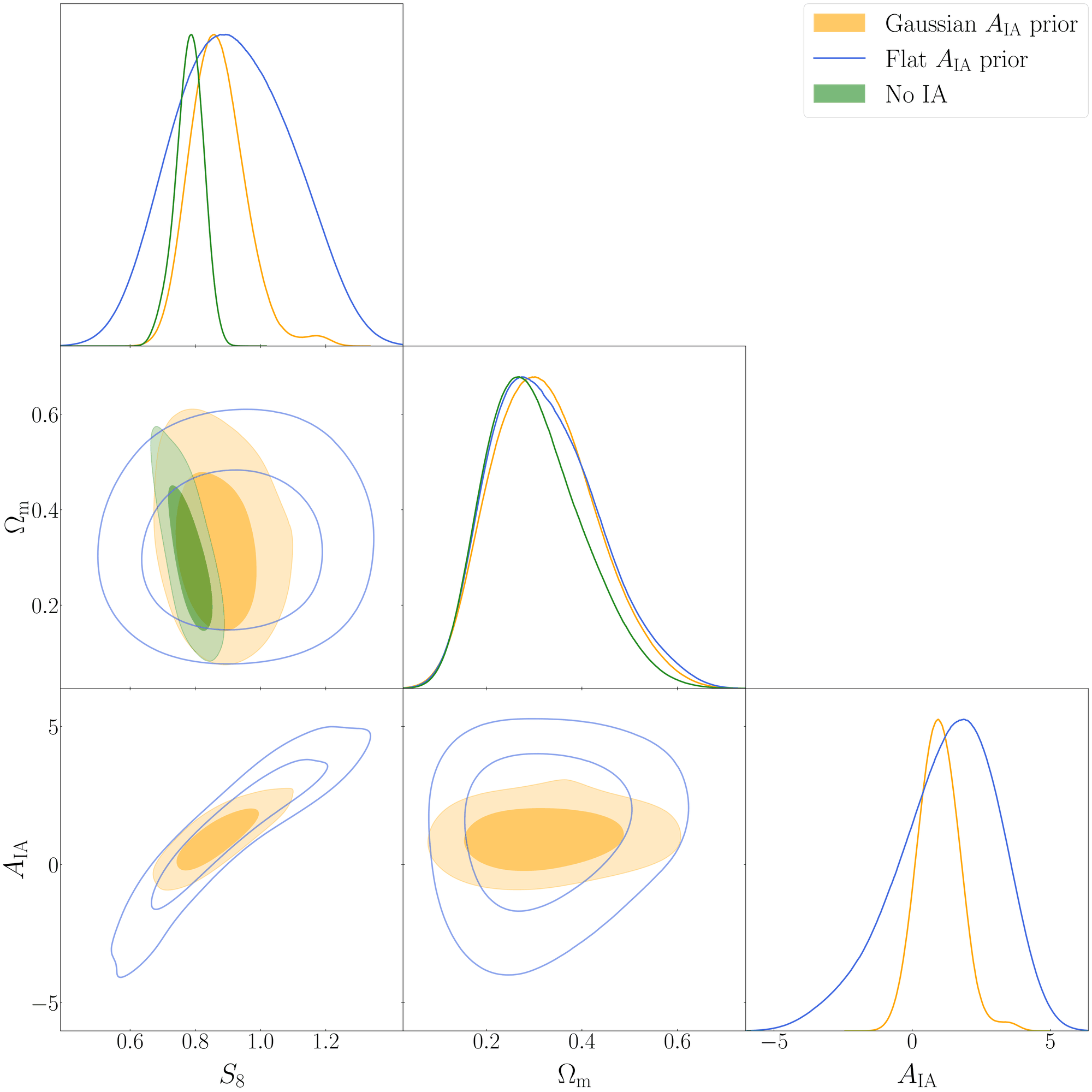
- \(A_\mathrm{IA}\) is the dominant nuisance: largely unconstrained, removing it shifts \(S_8\) by \(0.7\sigma\)
Two analyses agree to ~2σ, calibrated on 350 GLASS mocks
- Shared inputs: mocks calibrate the expected scatter between analyses
- 2.6% of mocks show a smaller \(\Delta S_8\)
- An unblinding criterion, to our knowledge a first for cosmic shear
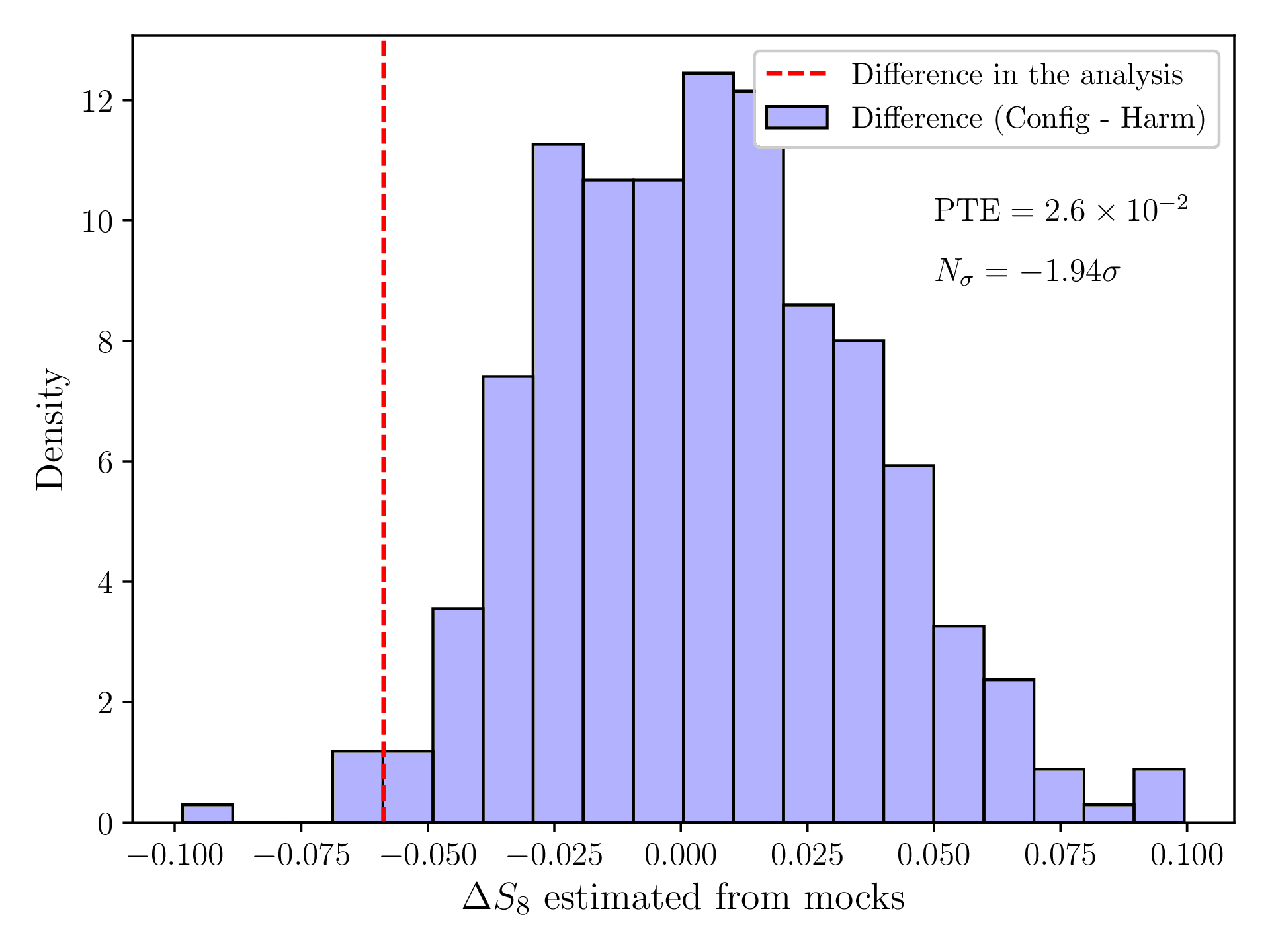
\(\Delta S_8\) between config and harmonic space:
data vs 350 GLASS mocks.
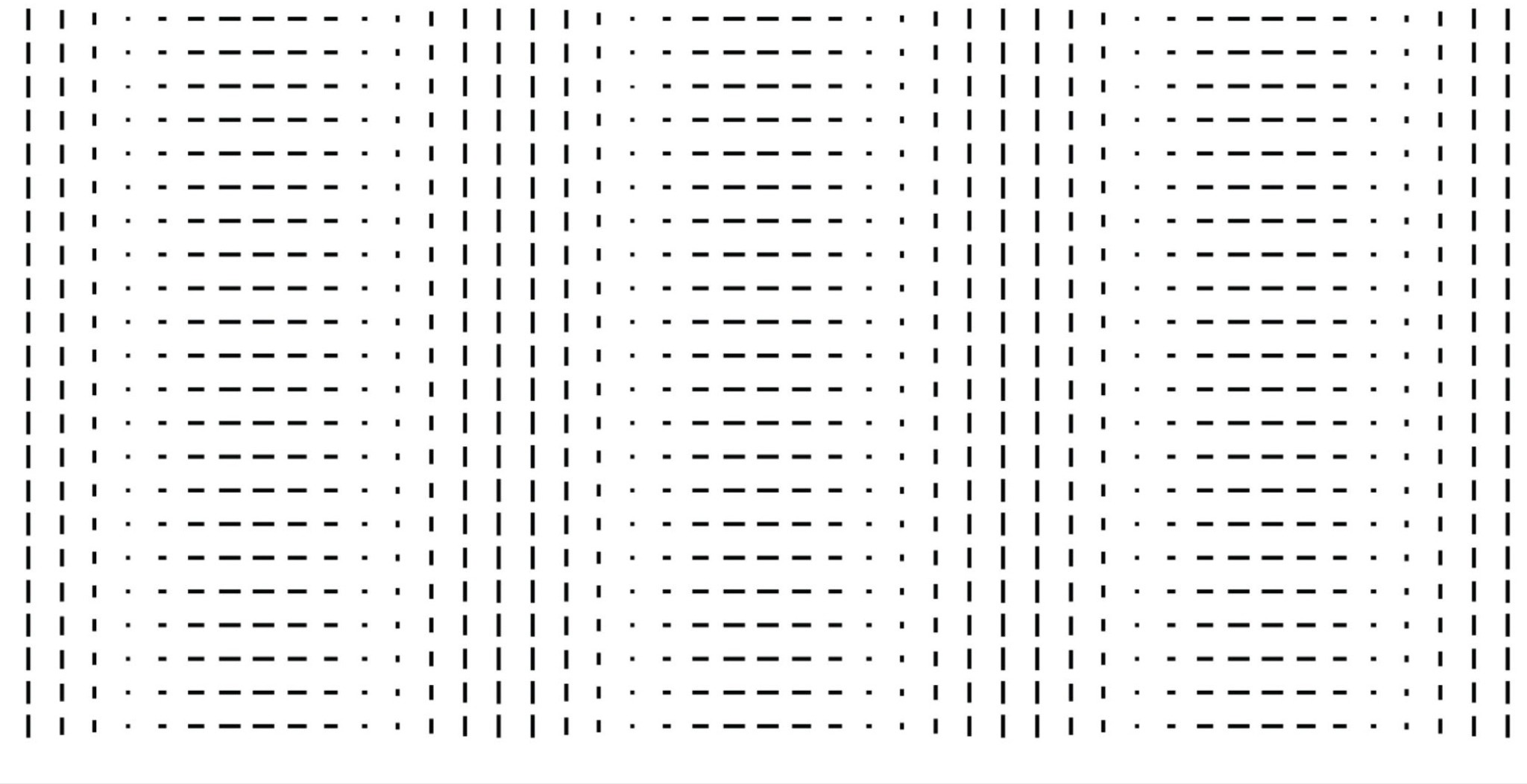
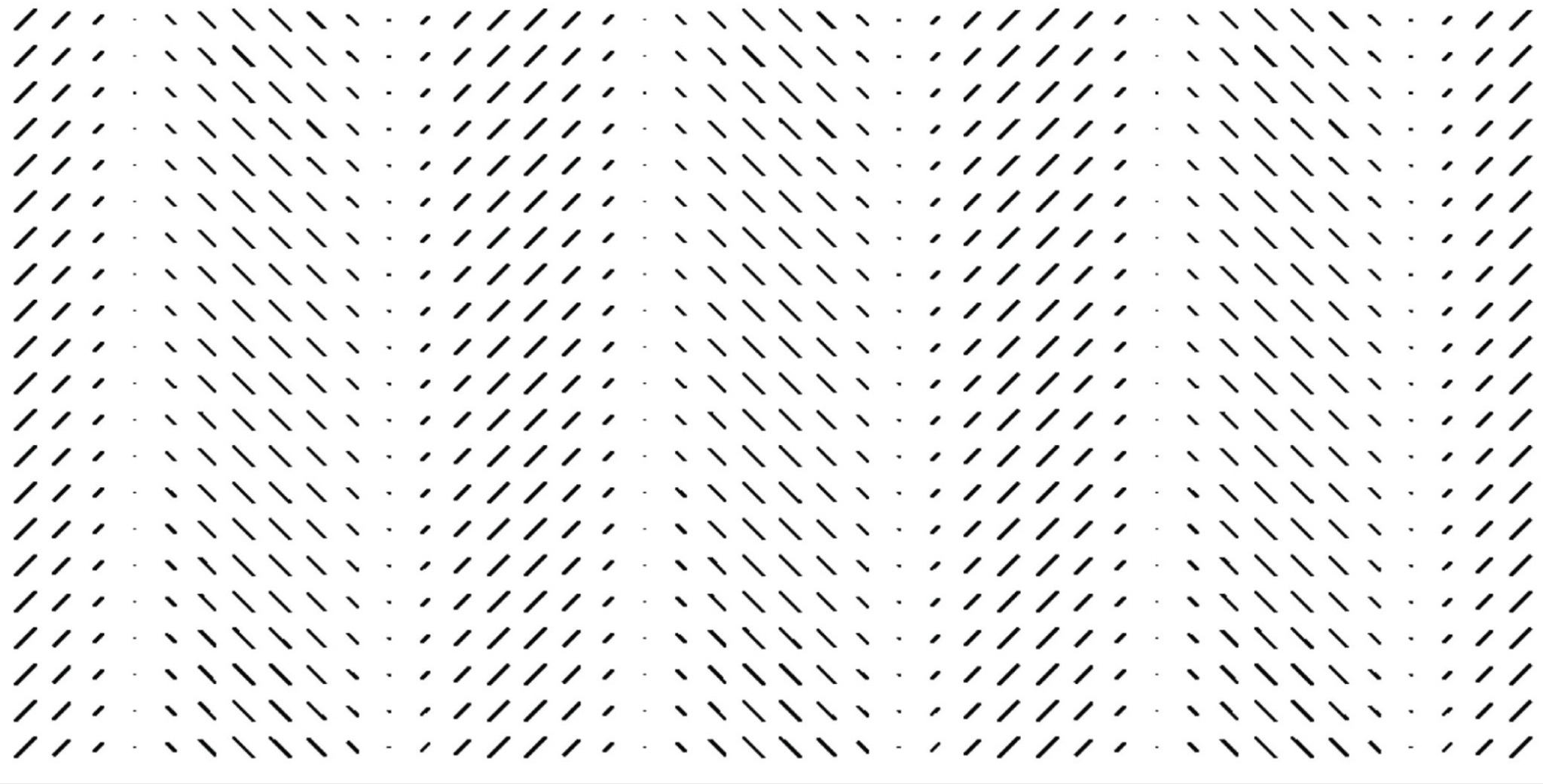
Masking creates ambiguous modes that require E/B-separable statistics
Spin-2 shear fields can be decomposed into E-modes containing the vast majority of lensing information and B-modes, which are a probe of systematics at UNIONS noise levels.
In the presence of masking, some ambiguous modes cannot be cleanly attributed to E or B.
\(\implies\) need E/B-separable statistics
Only the PSF size-corrected catalog passes across all statistics and scale cuts
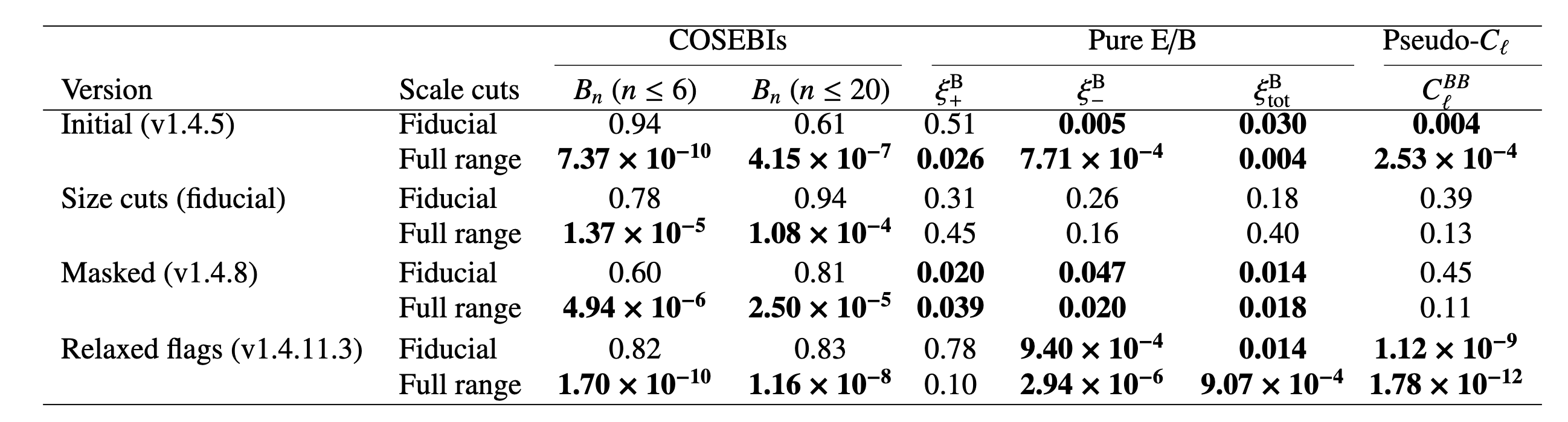
\(p\)-values for four catalog versions across fiducial and full-range cuts. Only the fiducial (PSF size-corrected) passes all three statistics.
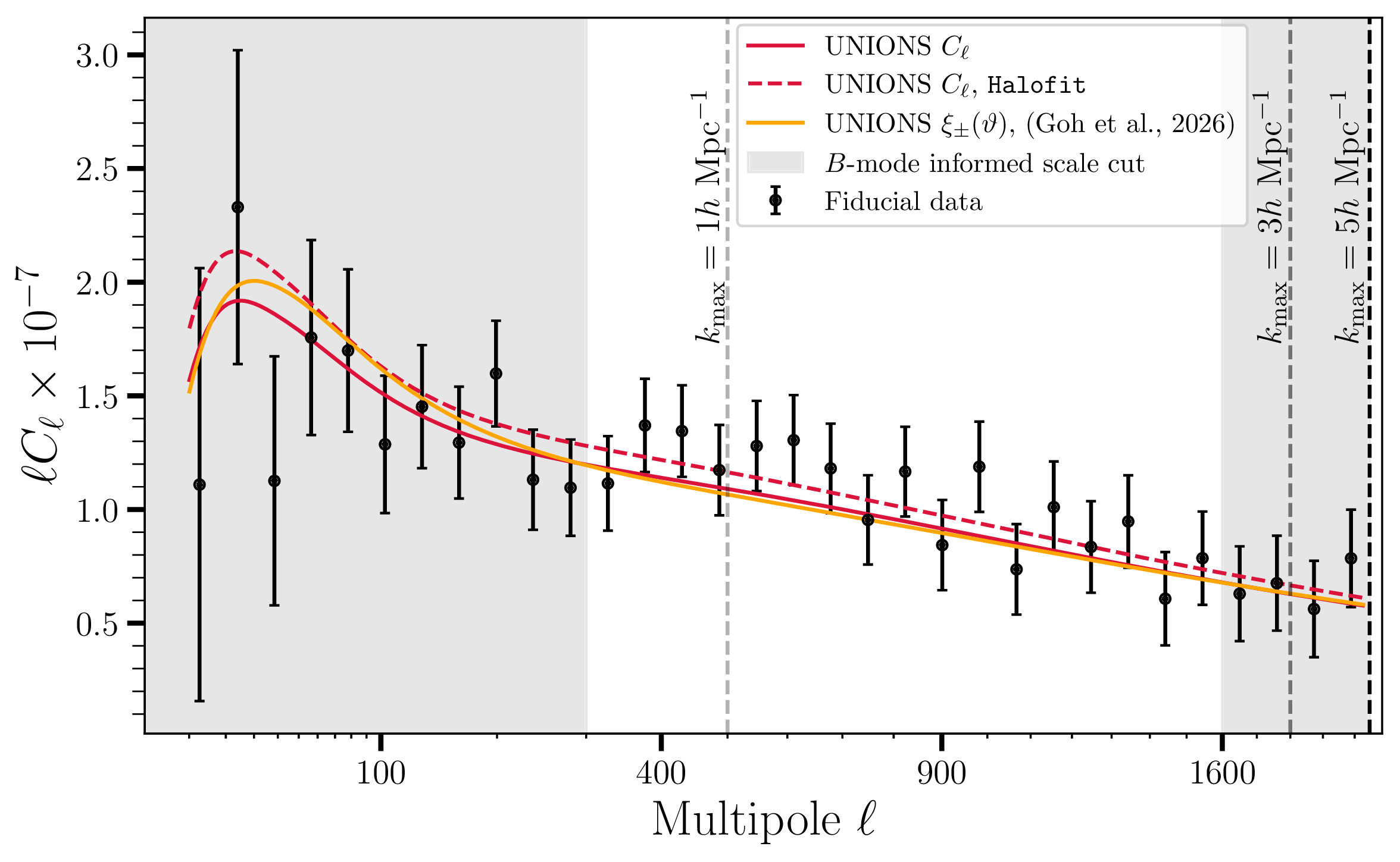
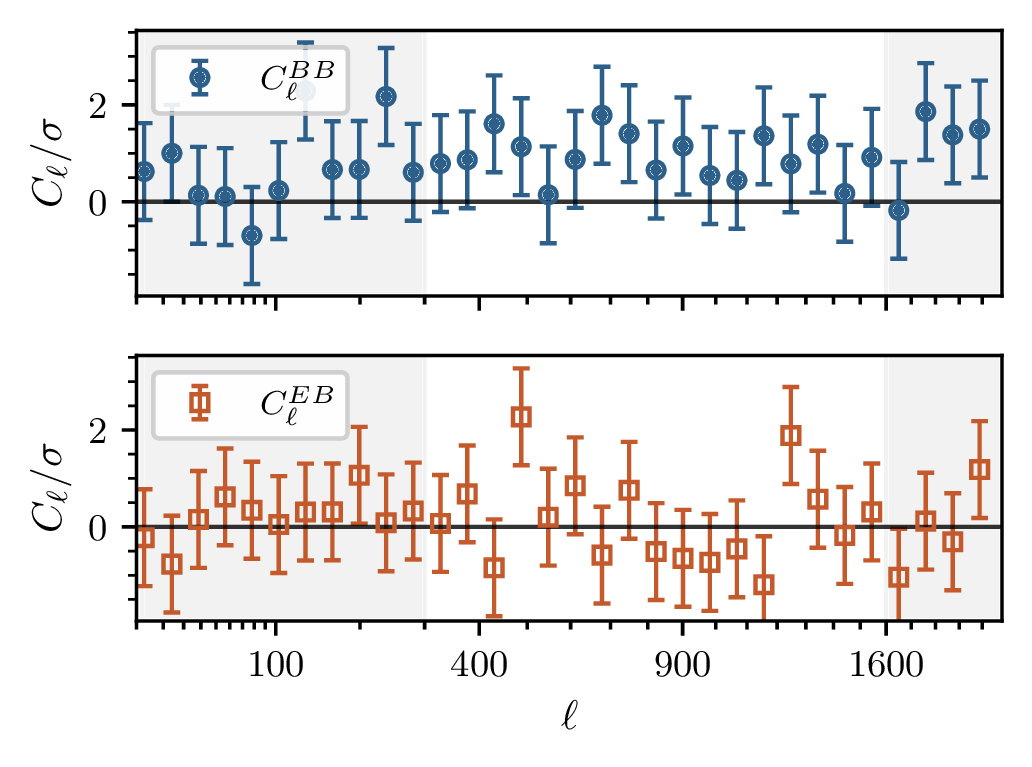
\(C_\ell^{BB}\) and \(C_\ell^{EB}\) are consistent with zero within the adopted scale cuts
NaMaster band-power estimation with mode-coupling correction.
Gray shading marks the harmonic-space scale cuts: \(\ell = 300\)–\(1600\).
Accidental unblinding by comparing maximum likelihood across blinds
- Dashed lines: maximum likelihood (no prior penalty)
- ML free to push \(\Delta z\) and \(A_\mathrm{IA}\) to extreme values that compensate the \(n(z)\) modification
- MAP (contours) rejects these, but ML reveals which blind is physical
\(A_\mathrm{IA}\) is unconstrained by the data but strongly affects \(S_8\)
\(S_8\)–\(\Omega_m\)–\(A_\mathrm{IA}\) from configuration-space inference.
- Gaussian \(A_\mathrm{IA}\) prior (orange) vs flat prior (blue) vs no IA (green)
- \(A_\mathrm{IA}\) is largely unconstrained by the data but strongly affects \(S_8\)
- A lower \(A_\mathrm{IA}\) gives lower \(S_8\)
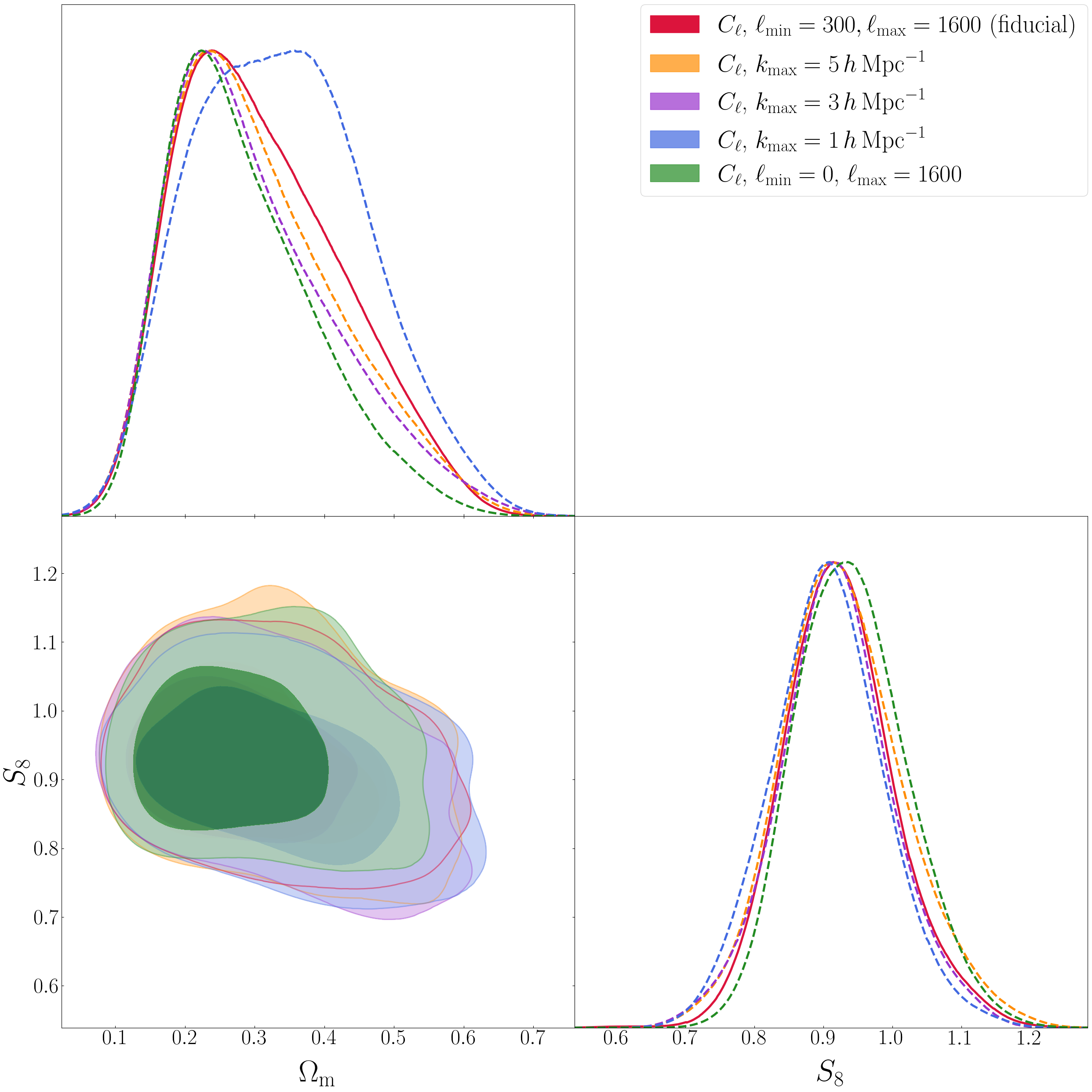
\(S_8\) is robust to \(k_\mathrm{max}\): nonlinear scale cuts shift constraints by \(< 0.2\sigma\)
- Fiducial \(\ell_\mathrm{max} = 1600\) (\(k_\mathrm{max} \approx 2.6\;h\,\mathrm{Mpc}^{-1}\))
- Tested \(k_\mathrm{max} \in [1, 3, 5]\;h\,\mathrm{Mpc}^{-1}\)
- All shifts \(< 0.2\sigma\) from fiducial
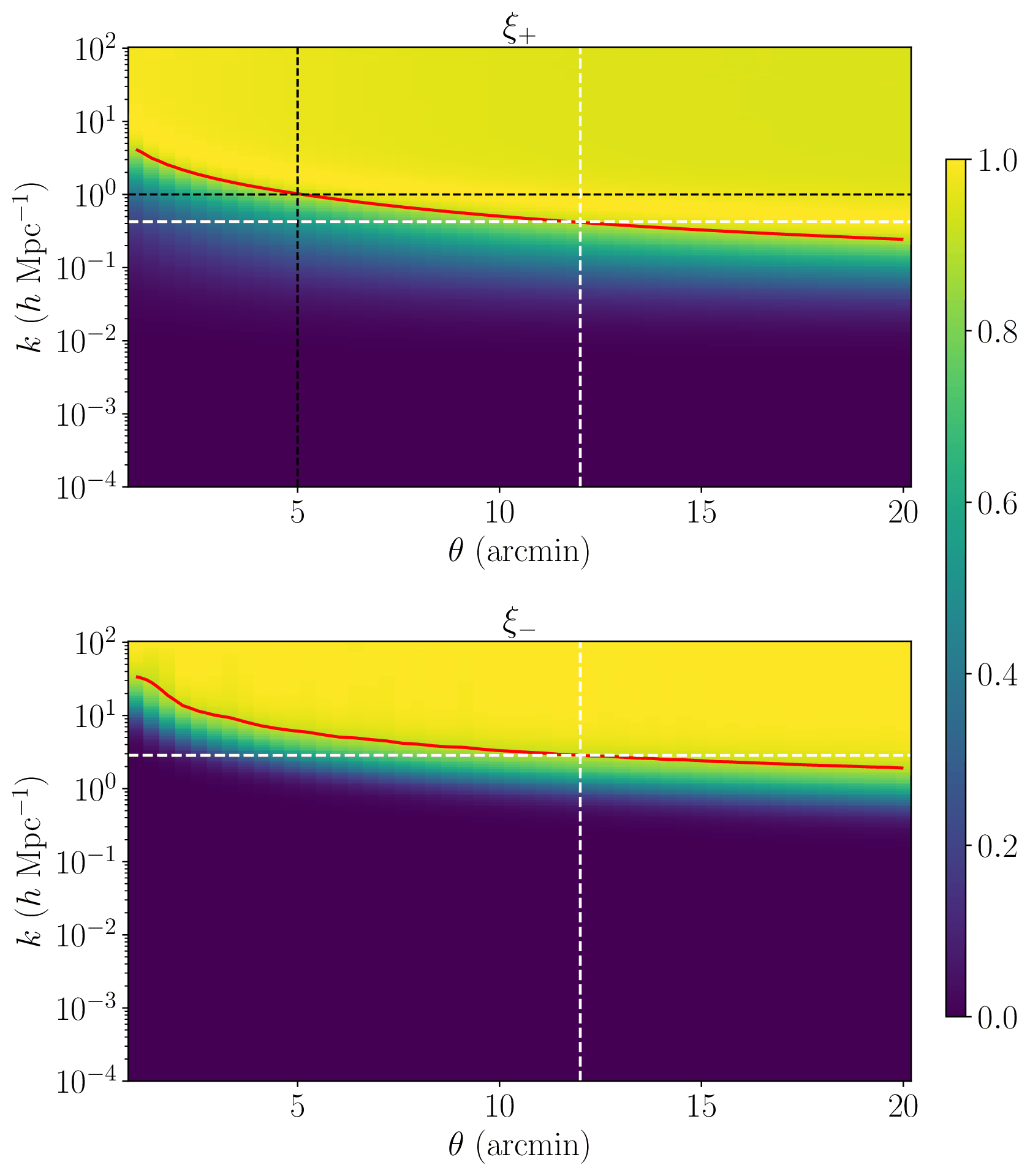
Angular scale cuts map to different \(k_\mathrm{max}\) for \(\xi_+\) and \(\xi_-\)
- Color: fraction of \(C_\ell\) signal from \(k < k_\mathrm{max}\) at each \(\theta\)
- Red curve: 90% signal boundary
- \(\xi_+\) at \(12'\): \(k_\mathrm{max} = 0.43\;h\,\mathrm{Mpc}^{-1}\)
- \(\xi_-\) at \(12'\): \(k_\mathrm{max} = 2.85\;h\,\mathrm{Mpc}^{-1}\)
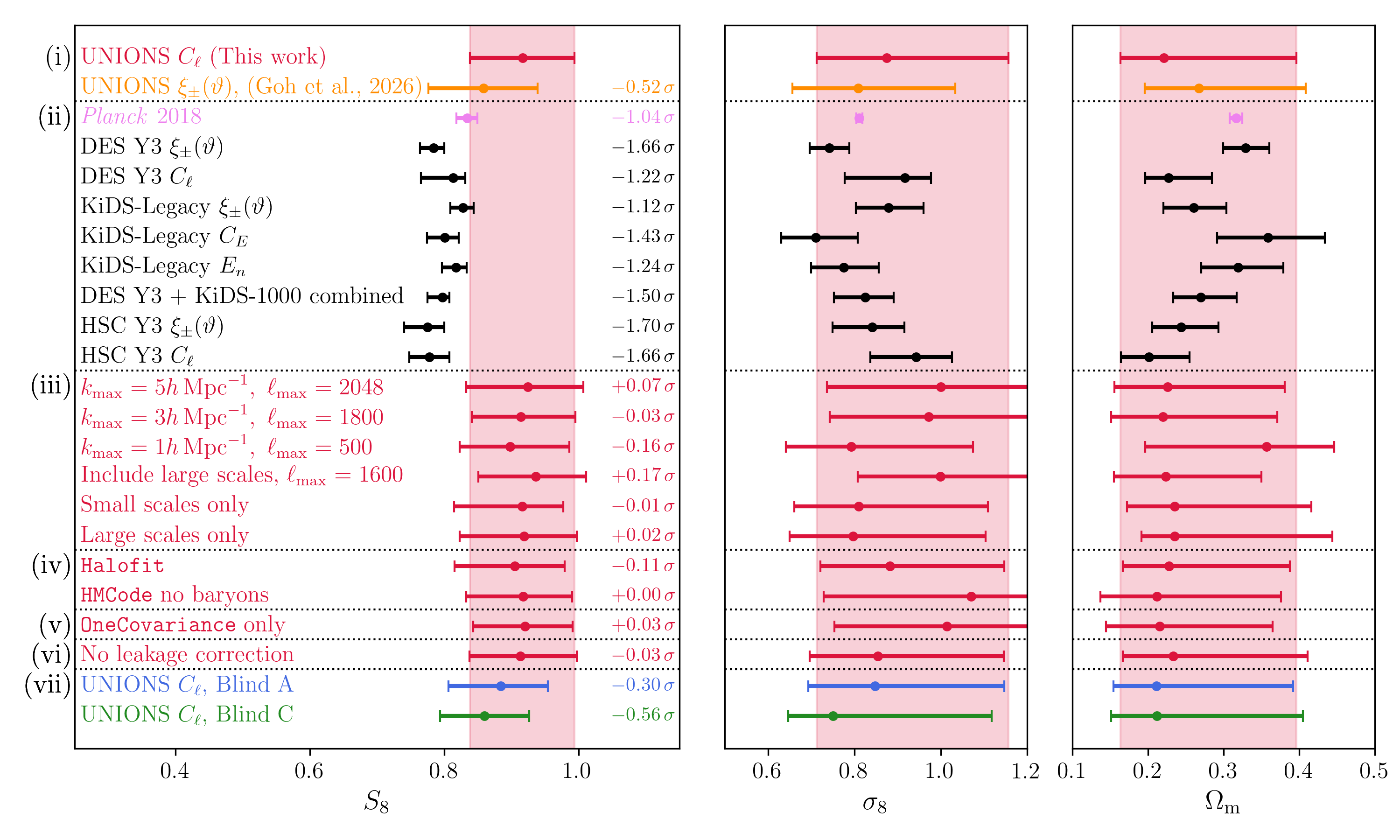
Harmonic-space \(S_8\) is robust to scale cuts and analysis choices
- Scale cuts, nonlinear model, covariance, and leakage choices all shift \(S_8\) by \(< 0.2\sigma\)
- Consistent across all three blinds
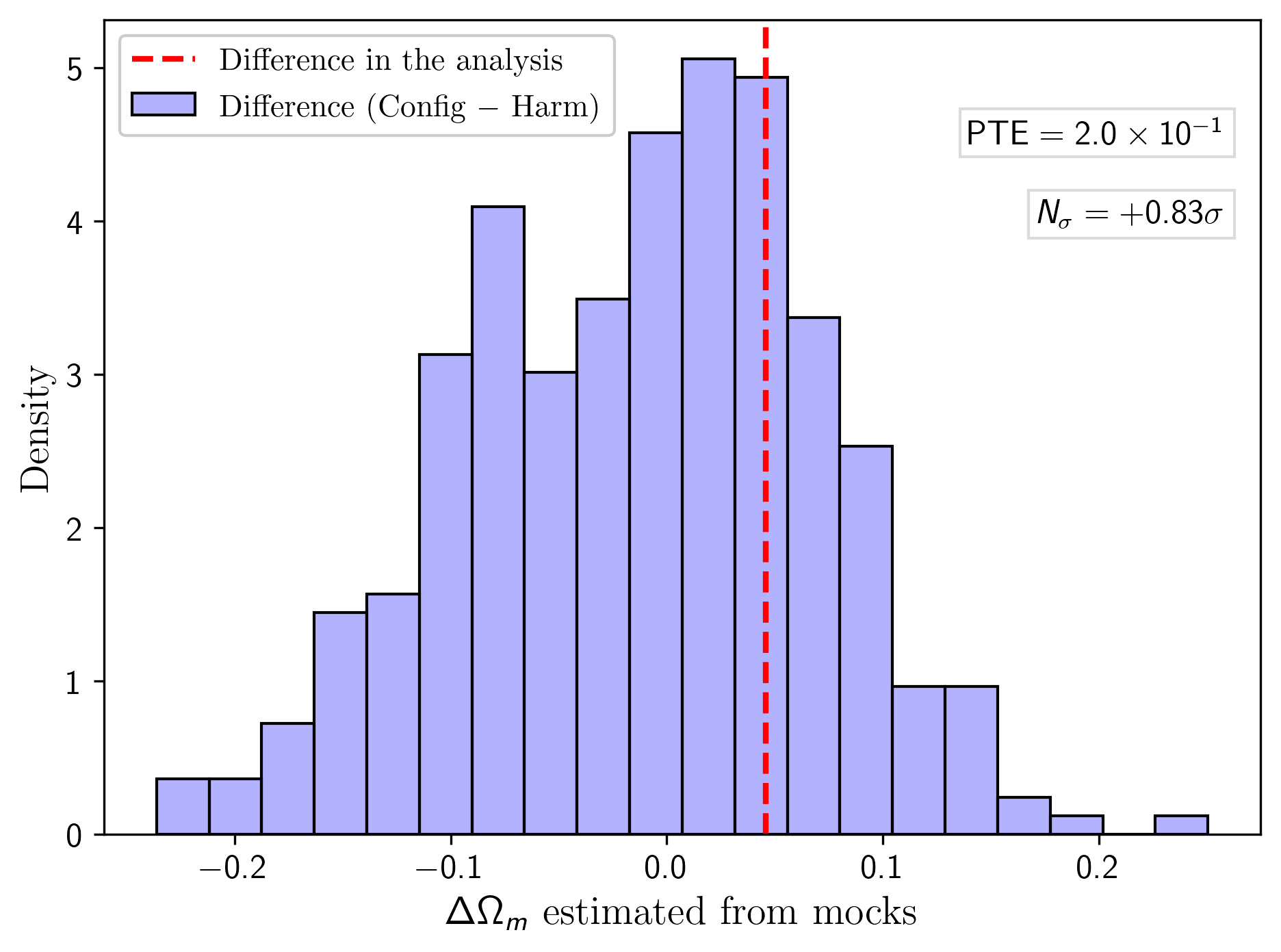
The \(\Omega_m\) difference between pipelines is unremarkable
- \(\Delta\Omega_m = 0.046\), PTE \(= 0.20\), \(N_\sigma = 0.83\)
- The tension is in \(S_8\) specifically, not a general disagreement
- Broad \(\Omega_m\) posteriors mean almost any difference is consistent
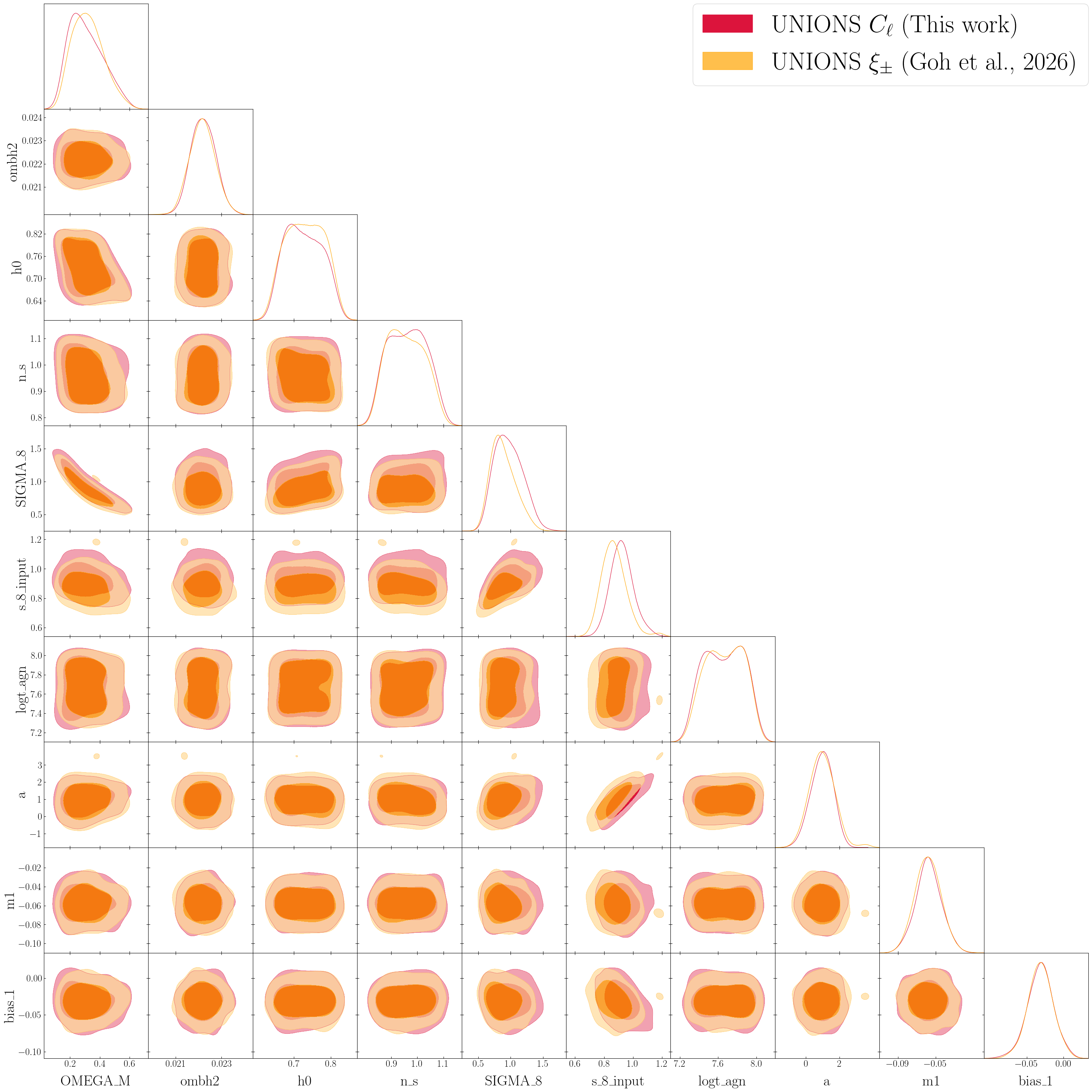
Config and harmonic posteriors agree across all parameters
UNIONS \(C_\ell\) (red) vs \(\xi_\pm\) (orange).
- Same blinded inputs
- Agreement across all parameters